Volkswagen Taos: Seats and head restraints
Front seats
Introduction
The following information describes the available options for adjusting the front seats. Always make sure the seats are adjusted to the correct position before driving ⇒  Introduction.
Correct seat adjustment is essential for comfort, vehicle control, and restraint system performance. In the Volkswagen Taos, the front seat should allow the driver to reach the pedals, steering wheel, gear selector, mirrors, and controls without leaning forward or sitting too close to the airbag.
WARNING
Driving in an incorrect seating position due to seats being adjusted incorrectly may cause serious injuries.
- Adjust the front seats according to the correct seating position each time before driving and make sure all passengers have their safety belts fastened correctly.
- Move the front passenger seat all the way back.
A seat that is too close to the dashboard, steering wheel, or airbag area can increase injury risk in a sudden stop or collision. The front passenger should sit upright with the backrest properly adjusted and the safety belt lying flat across the body.
WARNING
Adjusting the seats incorrectly can cause accidents and serious injuries.
- Only adjust the seats when the vehicle is stationary. Otherwise, the position of the seats could change unexpectedly while driving and you could lose control of the vehicle. You could also put yourself in an incorrect seating position.
- Only adjust the height, angle, and forward/back position of the front seats when there is no one within the seat's range of movement.
- Do not restrict the movement of the seats by placing objects within their range of movement.
- The adjusting and locking areas of the seats must not be dirty.
Before adjusting a seat, check that bags, floor mats, tools, bottles, clothing, or other objects are not blocking the seat tracks or moving parts. A blocked rail can prevent the seat from locking correctly or can damage the adjustment mechanism.
WARNING
Using seat covers or protective covers incorrectly can result in unintentionally operating the seat adjusters, and the front seats could move unexpectedly while driving. This could cause you to lose control of the vehicle. This can cause accidents and injuries. The electrical components in the front seats could also be damaged.
- Never install or secure seat covers and protective covers on the electrical controls.
- Only use seat covers or protective covers that are specifically approved for use in your vehicle.
Seat covers must not interfere with seat adjustment switches, side airbag areas, wiring, or seat movement. Poorly fitted covers can press on controls, restrict airbag deployment paths, trap heat, or rub against upholstery.
NOTICE
Objects with sharp edges can damage the seats.
- Never touch the seats with sharp-edged objects. Sharp-edged objects, such as zippers, rivets on clothing, or belts, can cause surface damage. Open hook and loop fasteners can also cause damage.
To preserve the seat surfaces, avoid sliding tools, keys, metal parts, hard luggage corners, or abrasive materials across the cushion or backrest. Clean dirt and grit from clothing or equipment before sitting on the seats.
Manually adjusting front seats
Please read the introductory information and heed the Warnings and Notice ⇒  and
and  Introduction.
The information that follows describes all possible controls. Depending on the seat version, the number of controls may vary.
The controls on the front passenger seat are a mirror image of those for the driver seat.
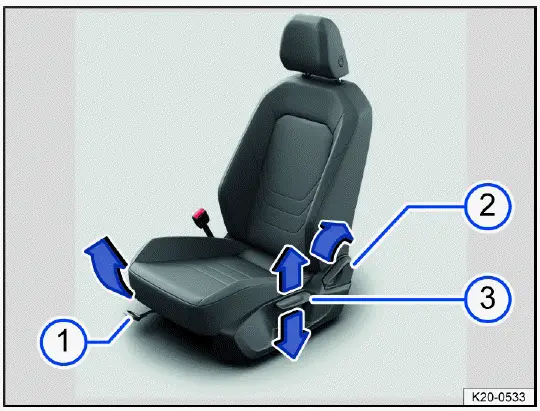
Fig. 65 On the driver seat: Controls.
- Pull the lever to slide the front seat forward or backward. The front seat must lock into place after the lever is released.
- To adjust the backrest, turn the handwheel with nothing resting on the backrest.
Or: release the backrest and operate the lever to adjust the backrest, depending on the vehicle equipment.
- If necessary, move the lever upward or downward multiple times to adjust the height of the seat.
1) This only applies to the inner side of the seat in vehicles with four doors.
After moving a manually adjusted seat, gently rock it forward and backward to verify that it has locked into position. If the seat moves after the lever is released, do not drive until the locking mechanism is correctly engaged.
Adjusting power front seats
Please read the introductory information and heed the Warnings and Notice ⇒  and
and  Introduction.
The electric controls differ depending on the country and vehicle equipment and may vary according to the seat design.
The controls on the front passenger seat are a mirror image of those for the driver seat.
A seat may have both manual and power controls.
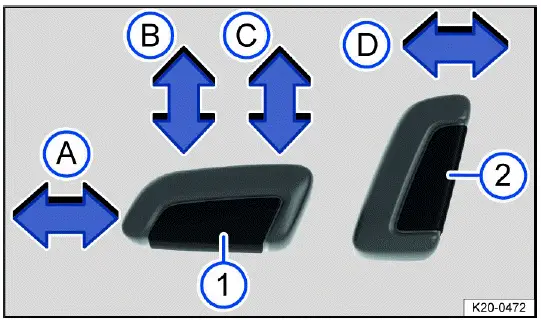
Fig. 66 Switch on the driver seat: Adjusting the front seat forward/back, the height and angle of the seat surface, and the front seat backrest.
Press the switch in the direction of the arrow:
- Slide the seat forward or backward.
- Adjust the angle of the seat surface.
- Adjust the height of the seat.
- Adjust the angle of the backrest.
Use small adjustments and check the driving position after each change. The seat should support the thighs and back without forcing the driver to stretch toward the pedals or sit too close to the steering wheel.
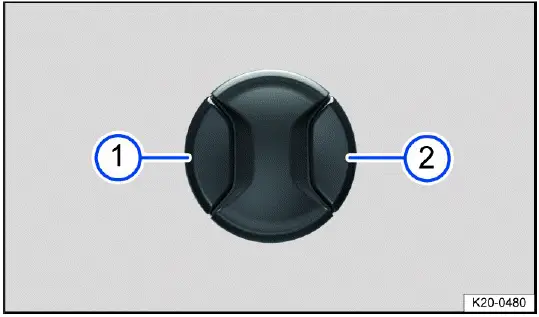
Fig. 67 Switch on the driver seat: Adjusting the lumbar support.
Press the switch in the direction you would like the lumbar support to move.
- Move the curvature of the lumbar support forward.
- Move the curvature of the lumbar support backward.
Lumbar support adjustment helps support the lower back during short trips and longer drives. Set it so the lower back feels supported without creating pressure points or pushing the body away from the backrest.
WARNING
Careless or unintended use of the power front seats can cause serious injuries.
- The power front seats can also be adjusted when the ignition is switched off. Never leave children or people requiring assistance in the vehicle.
- In case of an emergency, interrupt the power adjustment by pressing another switch.
Power seat movement can pinch hands, legs, feet, or objects caught near the seat rails or trim. Before using the controls, make sure no passenger, child seat, bag, or loose object is within the movement range.
NOTICE
Incorrect usage may damage the electric components in the front seats.
- Do not kneel on the front seats and do not otherwise concentrate pressure on specific points of the seat cushion and backrest.
Point loads can damage seat padding, heating elements, ventilation components if equipped, sensors, or internal wiring. Sit normally on the seat cushion and avoid pressing elbows, knees, tools, or heavy objects into one small area.
 If the charge level of the 12-volt vehicle battery is too low, it may not be possible to adjust the seat electronically.
 Seat adjustment is canceled while the engine is starting.
If power seat movement stops during starting or during a low-voltage condition, wait until the engine has started and electrical supply has stabilized before adjusting again. For Volkswagen Taos front seat adjustment problems that continue after the battery is charged, have the switches, wiring, seat motor, and related components inspected.
Rear seats
Introduction
The following information describes the available options for adjusting the rear seats. Always make sure the seats are adjusted to the correct position ⇒ Correct seating position. Correct rear seat positioning helps passengers sit upright, use the safety belts as intended, and maintain the designed protection of the restraint system.
In the Volkswagen Taos, the rear seating area is designed for passenger comfort and flexible cargo use. Before each trip, check that the rear backrests are locked, the seat belts are accessible, and no luggage or loose objects interfere with the seat mechanisms.
WARNING
Incorrectly positioned rear seats increase the risk of serious injuries if an accident occurs.
- Before every journey, ensure that the rear seats are positioned so that all passengers are sitting upright and have their safety belts fastened correctly.
- Only adjust the rear seats when there is no one within the range of movement of the seats.
A rear passenger should not ride with the backrest partly released, folded, or not fully engaged. If the backrest is not locked, it may move during braking, cornering, or a collision, reducing safety belt effectiveness and increasing the risk of injury.
WARNING
If you adjust the rear seats while driving, you will adopt the wrong sitting position. In addition, the rear seats may move unexpectedly during the journey. This will increase the risk of serious injuries if an accident occurs.
- Only adjust the rear seats when the vehicle is stationary.
Before adjusting the rear seat area, park the vehicle safely and make sure passengers have left the movement range. Never try to fold, release, or lock the rear backrest while the vehicle is moving.
WARNING
Incorrect use of the rear center armrest may cause serious injuries.
- The rear center armrest must always be folded up during journeys.
- If the center armrest is folded down, the center rear bench seat must never be used by either adults or children.
- Never allow an adult or child to ride on the center armrest.
The center armrest is not a seating position and is not designed to support an occupant during driving. When someone is using the center rear seat, the armrest must be raised so the passenger can sit correctly and use the safety belt properly.
NOTICE
Objects in the luggage compartment may get into the space between the seat and the luggage compartment floor when the rear seat is adjusted. This may cause damage.
- Remove all objects located between the seat and luggage compartment floor before you move the rear seat.
Small items such as tools, bottles, charging cables, child-seat accessories, or cargo hooks can become trapped when the backrest is folded or returned upright. Clear the area behind and below the rear seats before changing the seating or cargo layout.
NOTICE
Objects with sharp edges can damage the seats.
- Never touch the seats with sharp-edged objects. Sharp-edged objects, such as zippers, rivets on clothing, or belts, can cause surface damage. Open hook and loop fasteners can also cause damage.
To protect the upholstery, avoid dragging luggage, metal parts, tools, hard plastic cases, or abrasive materials across the rear seat surfaces. If cargo must rest near the seats, place it carefully and secure it so it cannot slide during driving.
Folding the rear bench seat backrest forward or backward
Please read the introductory information and heed the Warnings and Notice ⇒  and
and  Introduction.
The seat backrest is divided. Each part of the rear seat backrest can be folded forward individually to enlarge the luggage compartment. This split-folding design allows the Volkswagen Taos to carry longer items while still leaving part of the rear seat available when needed.
Before folding either section, remove loose items from the seat, check the rear floor area, and make sure the safety belts are not trapped. If a child restraint is installed, remove it or follow the child restraint manufacturer’s instructions before moving the backrest.
Folding the rear seat backrest forward and down with the release button
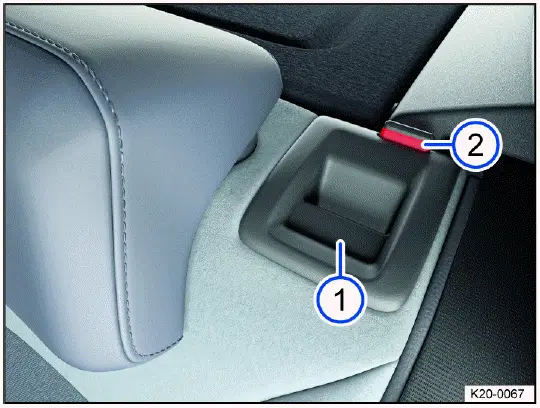
Fig. 68 In the rear seat backrest: release button.
1. Move the head restraints all the way down.
2. Pull the release button fig. 68 forward while folding the rear seat backrest forward and down.
The corresponding backrest part of the rear seat backrest is released when the red marking fig. 68 can be seen.
When the red marking is visible, the backrest is not locked for passenger use. Do not allow anyone to sit in that seating position until the backrest has been returned upright and securely engaged.
Folding the rear seat backrest up and back
1. Fold the rear seat backrest to the back and push firmly into the catch until it securely engages ⇒  .
.
The red marking fig. 68 must no longer be visible.
After raising the backrest, pull lightly on the top of the seatback to confirm that it is locked. Also check that the safety belt is not pinched behind the backrest and that the belt buckle remains accessible for the passenger.
NOTICE
Folding and unfolding the rear seat backrest in an uncontrolled or careless manner may cause damage to the vehicle or other objects.
- Before folding the rear seat backrest forward, always adjust the front seats so that the head restraint or padding on the rear seat backrest does not press against the front seats.
- Before folding the rear seat backrest forward, always take care that there are no objects in its path.
Do not drop the rear backrest suddenly or force it against the front seats, luggage, or trim panels. For Volkswagen Taos rear seat folding, smooth controlled movement helps prevent damage to the head restraints, seat padding, belt hardware, cargo floor, and interior side panels.
Head restraints
Introduction
The information that follows describes how the head restraints can be adjusted and removed. Always make sure the seats are adjusted to the correct position ⇒ Correct seating position. A correctly positioned head restraint helps support the head and neck area and can reduce injury risk during sudden braking, rear impacts, or other accident situations.
All seats are equipped with head restraints. The head restraints are specially approved for the relevant seat and should not be installed in another seat in the vehicle. Each head restraint is designed to match its seat position, guide spacing, locking mechanism, and intended protection area.
If a seat is occupied, select the correct head restraint setting for the respective head restraint. If a seat is not occupied, the respective head restraint can be pushed down as far as it will go. In the Volkswagen Taos, the head restraint should always be adjusted before driving, not after the vehicle is already moving.
The center rear head restraint, depending on vehicle equipment, is only intended for the center seat on the rear bench seat. Therefore, do not install this head restraint in any other position. Using a head restraint in the wrong seat may prevent it from locking correctly or providing the intended protection.
There are notches in the head restraint supports so that they can be locked in different positions. Only head restraints which are correctly mounted can lock into the notches within the adjustable range. To prevent the head restraints from being removed unintentionally after mounting, there are stops at the top and bottom of the adjustable range.
Correct head restraint adjustment
Adjust the head restraint so that the upper edge of the head restraint is in line with the upper portion of the head as much as possible, but not lower than eye level. Position the back of the head as close as possible to the head restraint. This position helps reduce excessive rearward head movement if the vehicle is struck from behind.
Head restraint adjustment for shorter persons
Slide the head restraint all the way down, even if the head is then below the upper edge of the head restraint. When the head restraint is in the lowest position, there may be a small gap between the head restraint and the backrest. The important point is to bring the restraint as close as possible to the occupant’s head while keeping the seating position upright.
Head restraint adjustment for taller persons
Move the head restraint up all the way. Taller occupants should check that the head restraint still supports the upper part of the head as effectively as possible and that the backrest angle does not place the head too far away from the restraint.
WARNING
Driving with head restraint that have been removed or adjusted incorrectly increases the risk of serious or fatal injuries in the event of an accident or sudden driving and braking maneuvers.
- If a person is sitting in a seat, always drive with the head restraint correctly installed and adjusted on that seat.
- If a person is sitting in a seat, adjust the head restraint according to their height.
- Never adjust the head restraint while driving.
A missing or poorly adjusted head restraint can greatly reduce the protection offered by the seat during an impact. Before every trip in the Volkswagen Taos, make sure all occupied seats have their head restraints installed, locked, and positioned for the person using that seat.
NOTICE
Removing and fitting the head restraints incorrectly may cause damage.
- When removing and installing the head restraint, make sure the head restraint does not hit the headliner, the front seat backrest, or other vehicle components.
Move the head restraint slowly during removal or installation. Forcing it at an angle can scratch trim, damage the guide rods, mark the headliner, or prevent the restraint from sliding smoothly afterward.
Adjusting the head restraints
Please read the introductory information and heed the Warnings and Notice ⇒  and
and  Introduction.
Adjusting the height of the head restraints
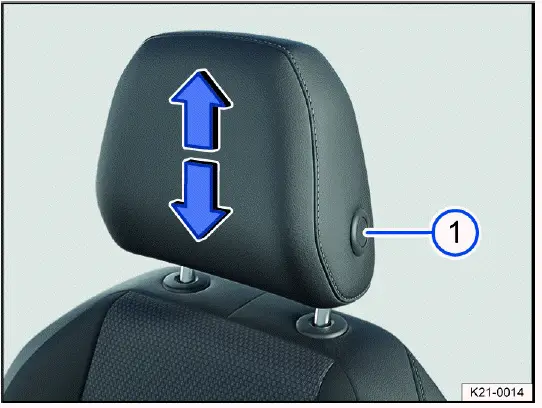
Fig. 69 Adjusting the front head restraint (general example).
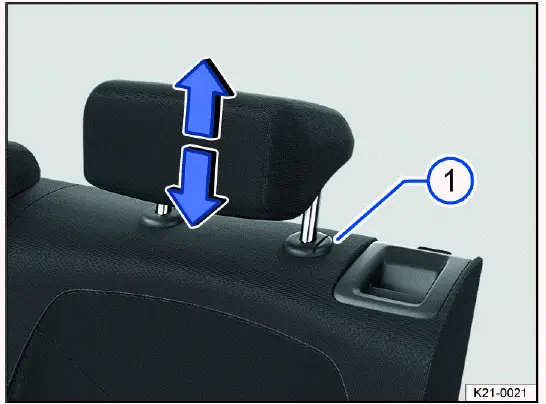
Fig. 70 Adjusting the rear head restraint (general example).
1. Slide the head restraint up or down in the direction of the arrow; you may need to press the fig. 69 or fig. 70 button first to release the head restraint.
The head restraint must lock securely into place. After adjusting, pull lightly upward and press gently downward to confirm that it is engaged in one of the locking positions and does not move freely.
For Volkswagen Taos head restraint adjustment, make small changes and check the occupant’s seating position again after the backrest and seat height have been set. Seat position, backrest angle, and head restraint height work together to create a safer posture.
Removing and installing the head restraints
Please read the introductory information and heed the Warnings and Notice ⇒  and
and  Introduction.
Removing the front head restraints
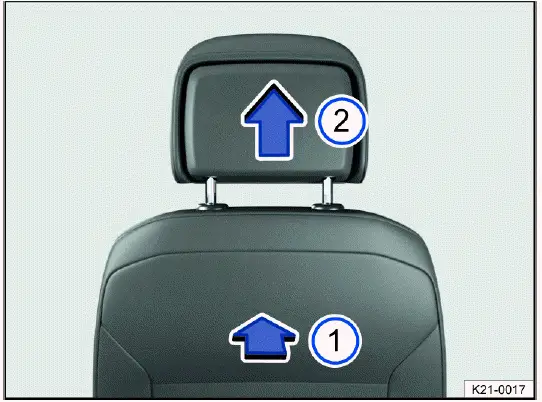
Fig. 71 Removing the front head restraint (general example).
1. Lower the head restraint if necessary.
2. To release, find the notch on the rear side in the marked area fig. 71, push inwards in the direction of the arrow and hold.
3. Pull out the head restraint in the direction of the arrow fig. 71.
Remove the head restraint only when necessary, for example for certain seat adjustments, cleaning access, or specific installation procedures. Do not drive with an occupied front seat if the head restraint has been removed.
Installing the front head restraints
1. Position the head restraint correctly above the head restraint guides and insert into the guides on the seat backrest.
2. Slide the head restraint downward until it engages into the guide rods.
3. Adjust the head restraint to the correct position.
After installation, check that both guide rods are inserted evenly and that the restraint locks into the adjustment notches. If it tilts, binds, or does not lock, remove it and reinstall it carefully before the seat is used.
Removing the rear head restraint
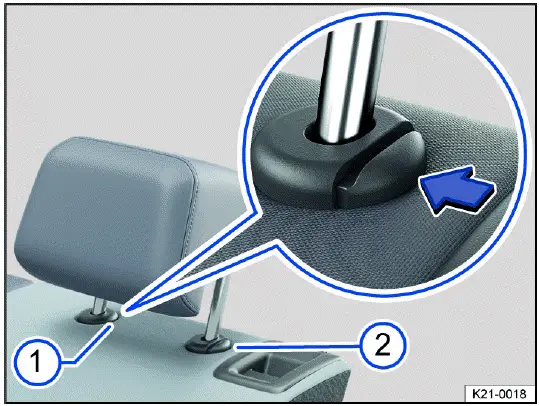
Fig. 72 Removing the rear head restraint (general example).
1. Release the backrest of the rear bench seat and fold forwards.
2. Slide the head restraint all the way upward ⇒ Adjusting the head restraints.
3. Press the button fig. 72 on the head restraint guide.
4. At the same time, press button fig. 72 while a second person pulls the head restraint all the way out.
5. Fold the rear bench seat backrest toward the rear and lock it securely into place.
Use care when folding the rear backrest and removing the head restraint so the guide rods do not strike the roof trim, rear seat surfaces, or luggage compartment trim. Keep the removed head restraint in a clean, secure place where it cannot be damaged or become a loose object.
Installing the rear head restraint
1. Release the backrest of the rear bench seat and fold forwards.
2. Position the head restraint correctly above the head restraint guides and insert into the guides on the seat backrest.
3. Push the head restraint downward while pressing the fig. 72 button.
4. Fold the rear bench seat backrest toward the rear and lock it securely into place.
5. Adjust the head restraint to the correct position.
After reinstalling the rear head restraint, confirm that the backrest is locked and that the red release marking, if present for the rear seatback, is no longer visible. For safe Volkswagen Taos rear seat use, every occupied rear seating position must have its head restraint installed and adjusted to the passenger’s height.
Seat functions
Center armrest
Front center armrest
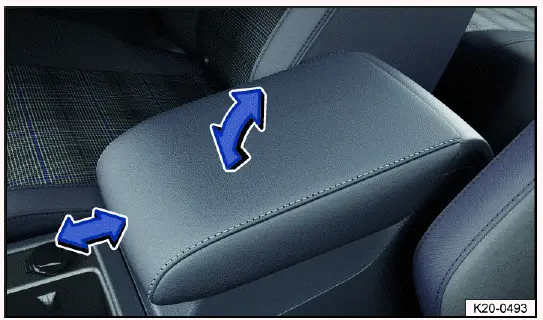
Fig. 73 Front center armrest (variant 1).
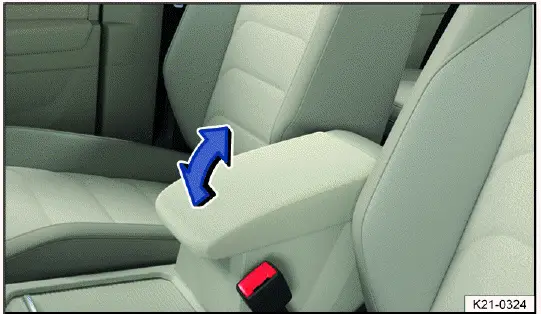
Fig. 74 Front center armrest (variant 2).
- To lift: Pull the center armrest up to the detents in the direction of the arrow fig. 73 or fig. 74.
- To lower: Pull the center armrest up fully. Then press the center armrest down.
- Forwards and backwards adjustment: slide the center armrest in the direction of the arrow all the way forwards or all the way rearwards fig. 73.
The front center armrest is designed to improve comfort for the driver and front passenger during normal driving. Depending on the selected position, it can support the forearm while still allowing access to the gear selector, steering wheel, seat belt buckle, and nearby controls.
Depending on vehicle equipment, there may be a storage compartment located under the center armrest. This compartment can be used for small items, but it should not be overloaded or left open while driving.
In the Volkswagen Taos, the front center armrest should be adjusted so it does not interfere with steering, shifting, fastening the safety belt, or operating the parking brake and console controls. If the armrest feels restrictive, lower it or slide it to a more comfortable position before driving.
WARNING
If the front center armrest is opened all the way or not completely closed, it can limit the driver's ability to move his or her arms, which can cause accidents and serious injuries.
- Always keep the storage compartments closed while driving.
- Never allow an adult or child to ride on the center armrest. This incorrect seating position can cause serious injuries.
Loose objects inside an open storage compartment may move during braking or cornering. Before driving, close the armrest lid securely and make sure no cables, accessories, or personal items are trapped in the hinge or latch area.
Rear center armrest
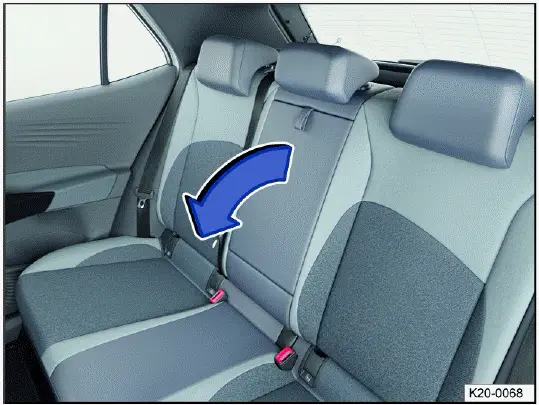
Fig. 75 In the backrest of the center seat: folding rear center armrest.
There may be a folding armrest in the backrest of the rear center seat. When folded down, it provides comfort for rear outboard passengers, but it also changes the way the center rear seating position can be used.
- To fold forward: pull the center armrest in the direction of the arrow using the loop fig. 75.
- To fold back: fold the center armrest upward in the opposite direction of the arrow fig. 75 and press it all the way toward the seat backrest.
Passengers must not sit in the center rear seat when the center armrest is folded down. The center position is only suitable for an occupant when the armrest is fully raised and the seat belt can be worn correctly.
WARNING
Incorrect use of the rear center armrest may cause serious injuries.
- If the center armrest is folded down, the center rear bench seat must never be used by either adults or children.
- Never allow an adult or child to ride on the center armrest.
The rear center armrest is not designed to support body weight during a crash, sudden stop, or sharp turn. Riding on it places the occupant in an unsafe position and prevents proper safety belt protection.
WARNING
Objects that are not secured or are secured incorrectly in the rear center armrest may be thrown around during sudden braking or driving maneuvers and can cause serious injuries.
- Store objects such as drinks in the storage compartments provided ⇒
 Introduction.
Use cup holders and storage areas only for items that fit securely. Heavy, sharp, hot, or fragile objects should not be placed loosely in or around the armrest because they may become dangerous during emergency braking.
NOTICE
Incorrect handling of the rear center armrest can cause damage to the seat and the center armrest.
- Remove all objects before folding back the rear center armrest.
Before returning the armrest to the backrest, check for cups, phones, cables, toys, or other items that may be caught between the armrest and seat. For Volkswagen Taos rear armrest care, fold it smoothly and avoid forcing it against any obstruction.