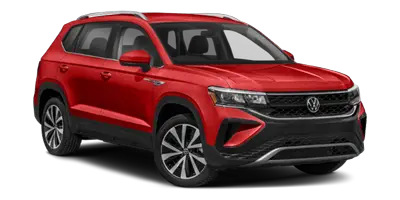
Volkswagen Taos: Driving
- Steering
- Pedals
- Brakes
- Start the engine
- Stopping the engine
- Start/Stop system
- Automatic transmission
- Driving on slopes
- Driving Mode Selection and 4MOTION Active Control
- Offroad display
- Off-road driving situations
- Messages about driving
Steering
Steering information
Steering
The Volkswagen Taos uses electromechanical power steering, which automatically adapts steering assistance according to driving speed, steering effort, and the angle of the front wheels. At lower speeds, such as when parking or maneuvering in tight spaces, the steering can feel lighter. At higher speeds, the system can provide a more stable and controlled steering feel. Electromechanical power steering operates when the engine is running, and the steering assistance also remains available if the start-stop system activates and temporarily switches the engine off.
If the power steering system is impaired or malfunctioning, a significantly greater amount of force than normal must be used to steer ⇒
 . In this situation, the steering wheel may feel unusually heavy, especially during parking, turning at low speed, or making quick steering corrections.
On vehicles with Driving Mode Selection, power steering handling can be influenced by the selected driving mode. Depending on the mode, the steering response may feel lighter, firmer, or more direct, allowing the Volkswagen Taos to adapt its steering character to comfort-oriented or more dynamic driving.
WARNING
Depending on the equipment, power steering may only work when the engine is running. If the power steering is not functioning, the steering wheel becomes stiff, making it much more difficult to steer. That can result in loss of control of the vehicle, accidents and serious or fatal injuries.
- Never let the vehicle roll when the engine is stopped.
Even if mechanical steering remains possible, the effort required can increase sharply without steering assistance. Avoid coasting with the engine off and respond immediately to any steering warning shown in the instrument cluster.
Troubleshooting
 Steering malfunction
The red warning light turns on or flashes.
The electromechanical steering is malfunctioning.
It may be difficult to move the steering wheel because the electromechanical steering system is malfunctioning. A red steering warning must be treated as a serious fault because steering assistance may be reduced or unavailable.
 Do not continue driving!
1. Contact an authorized Volkswagen dealer or authorized Volkswagen Service Facility for assistance. Do not attempt to continue driving the Volkswagen Taos if the steering wheel is hard to turn or if the red warning remains active.
 Steering malfunction
The yellow indicator light turns on or flashes.
The steering is stiffer or more sensitive than usual. The vehicle may still be drivable, but the steering behavior may not feel normal, so drive carefully and avoid sudden maneuvers.
The indicator light comes on permanently:
1. Restart the engine and drive the vehicle slowly for a short distance. This may allow the steering system to recalibrate or clear a temporary fault if conditions return to normal.
2. If the indicator light stays on, contact a suitably qualified professional. Volkswagen recommends contacting an authorized Volkswagen dealer or authorized Volkswagen Service Facility.
The indicator light blinks:
1. Turn the steering wheel back and forth slightly.
2. Switch the ignition off and back on.
3. Pay attention to the messages in the instrument cluster display.
4. If the indicator light continues to flash after switching the ignition back on, do not continue driving. Contact an authorized
Volkswagen dealer or authorized Volkswagen Service Facility for assistance. Continuing to drive with an unresolved steering fault can make the vehicle harder to control, particularly in traffic, on curves, or during evasive maneuvers.
Pedals
Information on the pedals
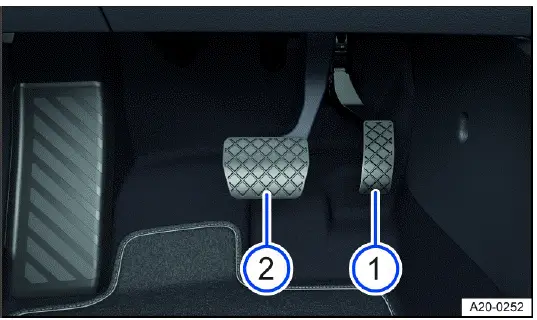
Fig. 90 In the footwell: pedals.
- Accelerator pedal.
- Brake pedal.
The pedals must always move freely and return to their normal position without interference. Before driving, make sure the driver footwell is clear and that the floor mat is correctly secured, because even a small loose object can slide under the brake pedal or accelerator pedal.
WARNING
Objects in the driver footwell can prevent the pedals from moving. This can cause the driver to lose control of the vehicle and increases the risk of serious or fatal injuries.
- Make sure all pedals can always be pressed without obstructions.
- Only use floor mats that are suitable for your vehicle.
- Always attach floor mats securely in the footwell.
- Never place floor mats or other carpet over the installed floor mat.
- Make sure no objects can enter the driver footwell while driving.
- Remove any objects from the footwell when the vehicle is parked.
- Wear shoes that give your feet good grip for operating the pedals.
Loose bottles, phones, tools, ice scrapers, stones from footwear, or unsecured mats can become dangerous if they move near the pedals. For safe Volkswagen Taos operation, the driver should be able to press the brake pedal fully and release the accelerator without any obstruction.
WARNING
Not paying attention to road traffic can cause accidents and serious or fatal injuries.
- Always comply with the applicable driving regulations and speed limits and think ahead while driving.
- Take regular breaks on long drives. You should take a break at least every two hours.
Fatigue can reduce concentration and reaction time before the driver fully notices it. On long trips, plan rest stops, keep the cabin comfortable, and avoid continuing to drive when attention begins to fade.
WARNING
Alcohol, drugs, medication, and prescription narcotics can considerably impair perception, reaction times, and driving safety, which can result in loss of vehicle control. This can cause accidents and serious or fatal injuries.
- Do not drive under the influence of alcohol, drugs, medication or prescription narcotics.
Some medications can cause drowsiness, slower reactions, blurred vision, or reduced coordination even when taken correctly. Always check medication warnings and do not drive if your ability to operate the vehicle safely may be affected.
WARNING
If a brake circuit is malfunctioning, the brake pedal may need to travel farther in order to stop the vehicle. A longer braking distance could cause accidents and serious or fatal injuries.
- Press the brake pedal down farther if braking power is reduced.
If the brake pedal feels unusually soft, travels farther than normal, or braking response changes suddenly, drive with extreme caution and have the braking system inspected immediately. Reliable pedal operation is essential for controlling speed, stopping distance, and overall driving safety.
Brakes
Information on the brakes
Breaking in brake pads
During the first approx. 200 to 300 km (approx. 100 to 200 miles), new brake pads do not yet provide their full braking efficiency and must first be "worn in" ⇒
 . During this initial period, the contact surfaces of the brake pads and brake rotors adapt to each other. You can compensate for the slightly reduced braking force by pressing more firmly on the brake pedal, but braking distance during full braking or automatic braking may still be longer than with brake pads that have already been broken in. For this reason, avoid unnecessary hard braking, aggressive stops, and driving too close to the vehicle ahead while the brake pads are new.
Brake pad wear
Brake pad wear depends heavily on driving conditions, road type, vehicle load, and driving style. Frequent city driving, repeated stop-and-go traffic, downhill routes, winding roads, and a sporty driving style can cause the brake pads to wear faster. If the Volkswagen Taos is often driven in these conditions, have the brake pads checked more frequently by suitably qualified professionals. Volkswagen recommends contacting an authorized Volkswagen dealer or authorized Volkswagen Service Facility.
External influences on the brake
When driving with wet brakes, for example after driving through water, in heavy rain, or after washing your vehicle, braking efficiency can be reduced by moisture or ice on the brake discs. You must "dry" the brakes as soon as possible by braking carefully at higher speeds. Use gentle brake pressure several times if needed, but only when traffic conditions allow it. Make sure there is no vehicle directly behind you and that you do not endanger anyone else on the road ⇒
 .
.
A coating of salt on the brake discs and brake pads reduces braking efficiency and increases braking distance. If you drive on salt-covered roads and do not apply the brakes for long periods, a layer of salt can remain on the friction surfaces. Brake carefully from time to time to remove this layer, making sure that the maneuver is safe and does not surprise other road users ⇒
 .
.
Leaving the vehicle parked for long periods, driving only short distances, low mileage, and avoiding firm braking can contribute to corrosion on the brake rotors and contamination on the brake pads. If light corrosion or dirt is present, occasional stronger braking at higher speeds may help clean the brake rotors and pads. This should only be done when road, weather, and traffic conditions are safe. Do not create danger for other vehicles, pedestrians, cyclists, or anyone else on the road ⇒
 .
.
Brake response in the Volkswagen Taos may also feel different after a long parking period, after washing the vehicle, or after driving through deep water. A slight scraping sound can sometimes occur when surface rust is being removed from the rotors, but persistent noise, vibration, pulling to one side, or reduced braking power should be inspected by a qualified professional.
WARNING
Driving with worn brake pads or a malfunctioning brake system can lead to a loss of control of the vehicle, accidents and serious or fatal injuries.
- If you suspect that the brake pads are worn or the brake system is malfunctioning, immediately find a suitably qualified professional and have the brake pads checked and worn brake pads replaced. Volkswagen recommends contacting an authorized Volkswagen dealer or authorized Volkswagen Service Facility.
Signs of possible brake wear or brake system problems can include longer stopping distance, unusual pedal feel, grinding noises, squealing, vibration through the brake pedal or steering wheel, or warning messages in the instrument cluster. Do not ignore these symptoms, especially if they appear suddenly or become worse during driving.
WARNING
Up to the first approx. 300 km (approx. 200 miles), new brake pads do not yet have their full braking efficiency and first need to be "worn in". Insufficient braking efficiency can increase the risk of accidents. This can cause serious or even fatal injuries.
- Increase the pressure on the brake pedal if reduced braking efficiency can be felt.
- To reduce the risk of accidents, serious injuries, and loss of vehicle control, drive with extra caution when the brake pads are new.
- During the break-in period for new brake pads, do not drive too close to other vehicles and avoid driving situations that place a heavy load on the brakes.
During the break-in period, keep a greater distance from traffic ahead and anticipate stops earlier than usual. Smooth braking helps the new pads seat correctly, while repeated hard braking can overheat the friction surfaces before they have fully adapted.
WARNING
Prolonged braking causes the brakes to overheat. This can considerably reduce braking performance, increase braking distance and possibly cause a total brake system malfunction. This can cause a loss of vehicle control, accidents, and serious or fatal injuries.
- Never let the brakes "rub" too often and too long or press the brake pedal too often and too long.
When driving downhill, avoid keeping constant light pressure on the brake pedal for a long time. Use a suitable gear or driving mode to help control speed where appropriate, and apply the brakes in a controlled manner instead of allowing them to overheat. Proper brake use helps maintain stable braking performance and supports safer Volkswagen Taos operation in demanding driving conditions.
WARNING
When driving downhill, a lot of force is placed on the brakes and they become hot quickly. Overheated brakes reduce braking efficiency and increase braking distance considerably. This can cause a loss of vehicle control, accidents, and serious or fatal injuries.
- Before driving on a long stretch of road with a steep gradient, reduce your speed by shifting down to a lower gear with a manual transmission or in tiptronic mode of the automatic transmission.
- Utilize the engine braking effect to reduce the load on the brakes.
- Before starting a journey, ensure that the air supply to the brakes is not covered, e.g. by aftermarket or damaged front spoilers.
On long descents, the brakes in the Volkswagen Taos should not be used continuously as the only way to control speed. Repeated or constant braking can build heat in the brake discs and pads faster than the system can dissipate it. Reducing speed before the downhill section begins and using engine braking helps keep the brake system available for situations where strong stopping power is truly needed.
WARNING
Wet, icy, or salt-covered brakes will take longer to brake and increase the braking distance. This can cause a loss of vehicle control, accidents, and serious or fatal injuries.
- Test the brakes carefully.
- Press the brake pedal carefully several times to dry the brakes and clear the ice and salt from them, as long as the visibility, weather, road, and traffic conditions permit.
After driving through standing water, heavy rain, slush, snow, or road salt, the brake response may feel weaker for a short time. Apply the brakes gently and repeatedly only when it is safe to do so, allowing moisture, ice, or salt residue to be removed from the friction surfaces without surprising traffic behind the vehicle.
 If you are having the front brake pads checked, the rear brake pads should be checked at the same time. Regularly check the thickness of the brake pads visually by inspecting them through the openings in the wheel rims or from underneath the vehicle. If necessary, remove the wheels so that the brake pads can be inspected. For further information, contact an authorized Volkswagen dealer or authorized Volkswagen Service Facility. Volkswagen recommends contacting an authorized Volkswagen dealer or authorized Volkswagen Service Facility.
Brake pad wear should be evaluated as a complete axle and system condition, not only as a single wheel check. Uneven wear, unusual noise, vibration, or a change in pedal feel may indicate that the brake components need inspection even if the vehicle still appears to stop normally.
Troubleshooting
 Brake system malfunctioning
The red warning light turns on. A message may also be displayed.
1.
 Do not continue driving! Contact an authorized Volkswagen dealer or authorized Volkswagen Service Facility immediately for assistance.
A red brake warning must always be treated as urgent. If this warning appears in the Volkswagen Taos, braking performance may be reduced, the hydraulic system may be affected, or another serious brake-related fault may be present. Stop safely as soon as possible and do not continue driving unless the vehicle has been checked and cleared for operation.
 Brake pad wear indicator
The warning light flashes or turns on red or yellow.
The front brake pads are worn. Depending on the warning and vehicle condition, the remaining pad material may be low enough that continued driving could damage other brake components or increase braking distance.
1. Immediately contact an authorized Volkswagen dealer or authorized Volkswagen Service Facility to have the system checked. Volkswagen recommends contacting an authorized Volkswagen dealer or authorized Volkswagen Service Facility.
2. Have all brake pads inspected and replaced, if necessary. When front pads are worn, the rear pads should also be inspected so the full braking system condition can be assessed accurately.
Braking Performance Reduced
If the brake pads are worn or if you notice that your vehicle does not brake as usual, e.g. the braking distance suddenly increases:
1. Immediately contact an authorized Volkswagen dealer or authorized Volkswagen Service Facility to have the system checked. Volkswagen recommends contacting an authorized Volkswagen dealer or authorized Volkswagen Service Facility.
2. Have all brake pads inspected and replaced, if necessary.
Reduced braking performance may also be noticed as a soft brake pedal, longer pedal travel, pulling to one side, a grinding sound, vibration during braking, or a delayed response after pressing the pedal. If any of these symptoms appear while driving the Volkswagen Taos, increase following distance, avoid sudden maneuvers, and arrange professional inspection without delay.
Start the engine
Remote start relay function
With the remote start relay function, the engine can be started remotely in order to warm up or cool down the vehicle interior before the journey begins.
The remote start relay function is intended to prepare the cabin temperature before the driver enters the vehicle. In the Volkswagen Taos, this can make the interior more comfortable in very cold or very hot weather, but the function must always be used responsibly and only where it is legally permitted.
The use of the remote start relay function may be regulated or prohibited regionally in some countries. Always observe legal and local regulations relating to the use of the remote start relay function. Local laws may restrict engine idling, remote starting in public areas, or the use of this feature in enclosed or semi-enclosed spaces.
Remote start relay conditions
The following conditions must be fulfilled simultaneously in order for the vehicle interior to be heated or cooled by the remote start relay function. If even one required condition is not met, the Volkswagen Taos may not start remotely or the process may be canceled automatically:
- The vehicle is fully ready to drive.
- The vehicle does not move.
- Sufficient fuel is available and the indicator light
 did not light up before the vehicle was parked.
 - The parking lock
 is engaged.
 - All doors, the hood and the trunk lid are fully closed and locked.
- The anti-theft alarm system has not triggered the alarm.
- The panic alarm is not activated.
- The emergency flashers are switched off.
- Two remote starts have not yet been carried out in direct succession.
Starting the Remote Start Relay Function
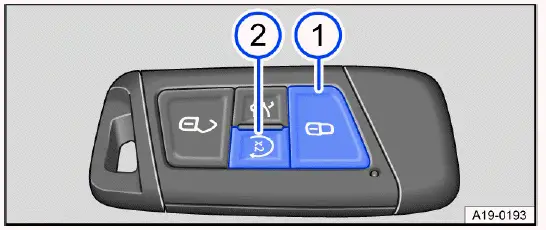
Fig. 91 On the remote control vehicle key: Button for remote start relay function.
- Button to lock the vehicle.
- Button for remote start relay function.
You must press the following buttons on the vehicle key within five seconds to start the engine using the remote start relay function ⇒
 . The button sequence is designed to prevent accidental remote starting from an unintended key press.
1. Press the button
 once fig. 91.
All turn signals will flash. This confirms that the first step of the remote start command has been received.
2. Press the
 button twice fig. 91.
All turn signals will flash. During remote start, the parking light turns on. These visual signals help confirm from outside the vehicle that the remote start relay process is active.
 For vehicles with Keyless Access, all valid vehicle keys which are in the vehicle interior have been blocked for this period of time.
If the remote start relay process is not actively canceled by the driver or automatically canceled, the engine will run for around 10 minutes. A maximum of two remote starts can be performed in a row, even if one or both remote starts have been interrupted within the 10 minute period. This limit helps prevent unnecessary idling, fuel use, and battery load.
1. In order to carry out two more remote starts, switch the ignition on and off once.
Ending the remote start relay
1. Press the
 button on the remote control vehicle key to switch off the engine fig. 91. Use this command if you no longer need the engine to keep running or if the vehicle will not be driven immediately.
Driving after a remote start relay
To be able to drive the vehicle after you have used the remote start relay function, you have to start the vehicle separately. Remote start prepares the cabin, but it does not replace the normal driver authorization process before driving.
1. Vehicles with starter button: Press the brake pedal and the starter button.
The engine continues to run during this process. Once the vehicle recognizes the valid key and the normal start procedure is completed, the Volkswagen Taos can be driven as usual.
Settings for automatic air conditioning with remote start relay
Climatronic: After the engine is started, the air conditioner automatically regulates the temperature of the vehicle interior to approx. +22 ºC (approx. +72 ºF) if it is in automatic mode
 . This helps create a balanced cabin temperature before the driver enters the vehicle.
Manual air conditioning system: After the engine is started, the air conditioner regulates the temperature of the vehicle interior to the most recently selected level. For best results, set the desired climate controls before parking if you plan to use remote start later.
If the engine has been started using the remote start relay function, the settings can be changed via the air conditioning system controls and the buttons for the windshield and rear window defroster, seat heating or ventilation, depending on the vehicle equipment. This makes it possible to adjust comfort features after entering the vehicle without waiting for a full climate reset.
Personal settings will be replaced by the automatic air conditioning settings the next time the vehicle is started using remote start relay. This means the system may return to predefined remote-start climate behavior instead of using the driver’s last manual adjustment.
1. To change the automatic air conditioning settings, contact a suitably qualified professional. Volkswagen recommends contacting an authorized Volkswagen dealer or authorized Volkswagen Service Facility.
Automatic remote start relay functions
Depending on the outside temperature and vehicle equipment, the following heating, ventilation and cooling system settings are automatically activated in the case of a remote start relay. These functions help prepare the Volkswagen Taos for driving by improving comfort and visibility before the trip begins:
- Heated spray jets for windscreen washer system.
- Heated windshield wiper parks.
- Rear window defroster.
- Exterior mirror heating.
- Steering wheel heating.
- Front seat heating.
- Front seat ventilation.
WARNING
Careless or unsupervised use of the remote start relay function may cause poisonous gases to enter the vehicle interior.
This can cause serious injuries and death due to asphyxiation.
- Never start the engine in an enclosed space, e.g. in a garage.
- Only use the remote start relay function when no-one is in the vehicle and immediately before you intend to drive the vehicle.
Exhaust gases can collect quickly in garages, carports with poor ventilation, underground parking areas, or near building entrances. Never use remote start in any place where exhaust cannot safely disperse into open air.
WARNING
When the engine is running, the electrical seats are operational. There is a risk of crushing and serious injuries.
- Never start the engine if children or animals are in the vehicle unsupervised.
- Never start the engine if the vehicle is out of visual range.
Remote start should only be used when the vehicle is visible and the area around it is safe. Do not use the function if anyone could operate controls, move seats, or be exposed to heat, cold, or exhaust-related danger without supervision.
WARNING
Hot vehicle parts and exhaust can ignite flammable or explosive materials in the vicinity. This can lead to a fire and cause accidents and serious or fatal injuries.
- Never start the engine close to flammable or explosive materials.
- Never start the engine if the vehicle is covered with a protective cover.
- Never start the engine if the vehicle is out of visual range.
- Never start the engine if the warning light
 is turned on or blinking.
Before using remote start, check that there is no dry grass, leaves, fuel vapor, cleaning chemicals, protective fabric, or other flammable material near the exhaust area. The engine and exhaust system can become hot even during a short remote-start cycle.
 Using the remote start relay function may increase fuel consumption and discharge the 12 V vehicle battery.
Use the function only when it provides a real benefit, such as preparing the cabin shortly before departure. Repeated remote starts without driving can place unnecessary demand on the vehicle battery and fuel supply.
 During an active remote start relay, some vehicle functions are deactivated, e.g. the low beam headlight and the windshield wipers.
This temporary limitation is normal during remote start operation. Full vehicle control becomes available only after the driver enters the vehicle and completes the normal start procedure.
Electronic immobilizer
The immobilizer helps prevent the engine from being started and the vehicle from being moved with an unauthorized vehicle key. It is an anti-theft function that allows engine operation only when a correctly coded key is recognized.
Vehicles with a Starter Button
In the remote control vehicle key, there is a chip used to automatically deactivate the electronic immobilizer when there is a valid remote control vehicle key in the vehicle interior. If the key is not recognized, the engine cannot be started in the normal way.
The electronic immobilizer is automatically engaged as soon as the ignition is switched off ⇒ Starter button. This helps secure the Volkswagen Taos when the vehicle is parked and the key is removed from the operating area.
 You can only start the engine with a suitably coded Volkswagen Original vehicle key. You can obtain coded vehicle keys from an authorized Volkswagen dealer or authorized Volkswagen Service Facility.
Starter button
The starter button replaces the ignition lock (Press & Drive).
The starter button allows the engine to be started without inserting a traditional ignition key. In the Volkswagen Taos, the system works together with the brake pedal and a valid vehicle key inside the cabin, making starting and switching the ignition on or off more convenient while still maintaining key-based authorization.
Start the engine with the starter button and by pressing the brake pedal. The brake pedal confirms that the driver is intentionally preparing the vehicle for operation.
The vehicle can only be activated when there is a valid vehicle key inside the vehicle. If the key is outside the vehicle, shielded by another object, or not detected correctly, the starter button may not start the engine.
Switching the ignition on or off
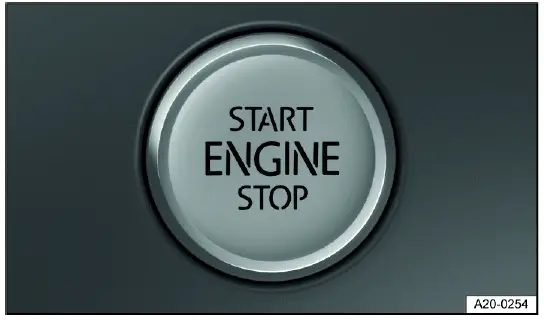
Fig. 92 In the lower section of the center console: starter button.
1. Press the starter button once without pressing the brake or clutch pedal ⇒
 . This switches the ignition on or off without starting the engine, allowing certain electrical systems to be used when needed.
Automatic ignition switch off
If the vehicle recognizes that the driver is absent when the internal combustion engine is switched off, the ignition is automatically switched off after a certain amount of time. This helps protect the 12 V vehicle battery and reduces the risk of electrical consumers remaining active unintentionally.
Engine restart function
If no valid remote control vehicle key is detected in the vehicle interior after the engine has been inadvertently switched off, the engine cannot be started within approximately five seconds. This short restart window is intended for situations where the engine was switched off accidentally and the system still allows a quick recovery.
Once this time has elapsed, the vehicle can no longer be started without a valid vehicle key inside the vehicle. For normal Volkswagen Taos operation, always keep the authorized key with the driver before attempting to start or move the vehicle.
WARNING
If the brake pedal is pressed when switching on the ignition, the engine will start immediately. This can cause unintentional vehicle movement and serious injuries.
- Avoid pressing the brake pedal when switching on the ignition if the engine is not intended to be started.
Before pressing the starter button, make sure the transmission position, parking brake status, and surrounding area are safe. This is especially important in tight parking spaces, garages, service areas, or anywhere the vehicle could move unexpectedly.
WARNING
If you leave vehicle keys unattended in the vehicle, children or unauthorized people could lock the doors and/or the trunk lid, start the engine, or switch on the ignition and thereby activate electrical equipment, such as the power windows. This can cause accidents and serious or fatal injuries.
- Always take all vehicle keys with you when leaving the vehicle.
WARNING
If you leave children, people requiring assistance or animals unattended in the vehicle, they may accidentally set the vehicle in motion or be subjected to very high or low temperatures. There is a risk of accidents and serious or fatal injuries.
- Never leave children, people requiring assistance or animals unattended in the vehicle.
 Always switch the ignition off manually before leaving the vehicle and note any messages in the instrument cluster display.
 The vehicle being stationary for long periods with the ignition switched on can cause the 12 V vehicle battery to drain and then it will not be possible to start the engine.
Start the engine
Start the engine
1. Switch the ignition on.
2. Press and hold the brake pedal until the electronic parking brake has been switched off. Keep your foot firmly on the brake so the vehicle remains controlled during the start procedure.
3. Vehicles with an automatic transmission: Move the selector lever to the
 position or engage the
 parking lock.
4. Vehicles with starter button: Press and hold the starter button ⇒ Starter button and do not press the accelerator pedal. The engine management system controls the starting process automatically, so pressing the accelerator is not necessary.
For the engine to start, a valid vehicle key must be inside the vehicle and the brake must be pressed. Release the starter button once the engine starts. If the engine does not start immediately, avoid repeated long starting attempts.
5. If the engine does not start, stop the starting procedure and try again after approximately one minute. Waiting briefly can help protect the starter and electrical system from unnecessary load.
6. Vehicles with starter button: If the vehicle was locked with the vehicle key, the starter button will be deactivated. If you are in the vehicle and you need to start the engine, first unlock the vehicle or perform an emergency start.
WARNING
Starting the engine in unventilated or enclosed spaces may cause poisonous gases to enter the vehicle interior. This can cause serious injuries and death due to asphyxiation.
- Never start the engine or let it run in unventilated or enclosed spaces, such as in garages.
Exhaust gases can build up quickly in enclosed spaces, even if doors or windows are partly open. Only start the Volkswagen Taos where exhaust can safely disperse into open air.
WARNING
Hot vehicle parts and exhaust can ignite flammable or explosive materials in the vicinity. This can lead to fires and cause accidents and serious or fatal injuries.
- Never start the engine or leave the engine running if oil, fuel or other flammable operating equipment is in the vicinity of the vehicle or is escaping from the vehicle.
- Do not use any start boosters.
Before starting, check that there are no flammable materials, fuel vapors, dry leaves, cleaning chemicals, or protective covers near the exhaust area. The exhaust system can become hot shortly after the engine starts.
WARNING
An unattended vehicle which is ready to drive may cause accidents and severe injuries.
- Never leave the vehicle unattended when the engine is running, especially if a gear is engaged.
If the engine is running, remain in control of the vehicle. Do not leave the driver seat unless the vehicle is safely parked, the parking lock is engaged, and the ignition has been switched off as required.
NOTICE
Incorrect handling of the vehicle can increase wear to components, such as the starter, or cause damage.
- If the engine does not start, e.g. the fuel tank is empty, never use the starter with a gear engaged to drive or to attempt a tow-start.
- If necessary, refill with fuel as per or use jump-start.
- If the engine does not start, contact an authorized Volkswagen dealer or authorized Volkswagen Service Facility.
Repeated starting attempts without identifying the cause can strain the starter, battery, and related electrical components. If the Volkswagen Taos does not start after the recommended procedure, check basic conditions such as fuel level, key detection, battery status, and displayed messages before seeking service support.
NOTICE
Incorrect handling of the vehicle can increase wear to components, such as the engine, or cause damage.
- Avoid restarting the engine while driving or directly after turning off the engine.
- Avoid high engine speeds, full acceleration and heavy engine loads when the engine is cold.
- Be aware that at high altitudes, the air density is lower, which can make it more difficult to start the engine.
After a cold start, drive smoothly until the engine reaches a suitable operating temperature. Gentle acceleration and moderate engine load help reduce wear and allow oil to circulate properly through the engine.
NOTICE
Uncombusted fuel can damage the catalytic converter.
- Do not tow-start or push-start the vehicle.
 Do not let the engine run to warm up while the vehicle is parked. Begin driving as soon as there is enough visibility through the windows. This allows the engine to reach its operating temperature sooner and reduces the emissions.
 Electrical equipment with an increased power draw is temporarily switched off when the engine is started.
 If there is no vehicle key in the vehicle or the key is not detected, a message will appear in the instrument cluster display.
This can occur if another signal interferes with the remote control vehicle key or if the remote control vehicle key is covered by an object, such as a metal case.
Key detection can also be affected if the vehicle key is close to electronic devices, stored in a bag with metal objects, or located in an area of the cabin where the signal is shielded. Move the key to a clear location inside the vehicle and try again.
 If the vehicle key button cell battery is low or drained, the engine cannot be started with the starter button. Perform an emergency start.
 After starting, operating noises may be temporarily higher than usual while the engine is cold. This is normal and not a cause for concern.
Temporary higher idle speed or slightly louder engine operation after a cold start can occur while the system stabilizes combustion and emissions control. If unusual noises continue after the engine warms up, have the vehicle checked by a qualified professional.
Troubleshooting
 Engine control malfunction
The yellow indicator light turns on.
Engine control is malfunctioning. In the Volkswagen Taos, this warning means that the engine management system has detected a fault that may affect performance, emissions, fuel delivery, ignition control, or other engine-related functions.
1. Pay attention to any text shown in the Volkswagen Digital Cockpit display. The message may provide additional instructions, such as whether reduced driving performance is active or whether the vehicle should be checked immediately.
2. Have the engine checked immediately by a suitably qualified professional. Volkswagen recommends contacting an authorized Volkswagen dealer or authorized Volkswagen Service Facility. Continuing to drive without diagnosis may allow a minor engine control issue to become more serious.
 Engine control malfunction
The indicator light comes on in the Volkswagen Digital Cockpit.
The yellow indicator light turns on.
The driving performance of the vehicle is limited. Acceleration may feel weaker than usual, the engine may respond more slowly, and the vehicle may not deliver normal power.
The driving performance has been limited to prevent the engine control components from overheating. This protective function helps reduce thermal stress on sensitive engine and electronic components.
- A corresponding indicator may appear in the instrument cluster display.
- It is possible to continue driving with reduced driving performance.
If reduced performance is active, drive calmly and avoid full acceleration, high engine load, steep climbs at high speed, or heavy towing. The Volkswagen Taos should be inspected if the warning remains active or returns after the vehicle has cooled down.
The driving performance limitation is removed in the following scenarios:
- The engine control components are no longer within a critical temperature range.
 Engine speed limited
The yellow indicator light turns on.
The engine speed has been limited to reduce the risk of the engine overheating. This means the control system is restricting RPM to help protect the engine from damage.
The instrument cluster display shows the engine speed. Do not try to force the engine beyond the indicated limit, and avoid aggressive acceleration until the cause is resolved.
The engine speed limitation is removed in the following scenarios:
- The engine is no longer within a critical temperature range.
- The driver's foot is removed from the accelerator pedal.
 together with
 Engine speed limitation due to engine control malfunction
The yellow indicator lights turn on.
The engine speed limitation is triggered by an engine control malfunction. The Volkswagen Taos may still be able to move, but engine output and RPM are being restricted because the system has detected a fault that requires attention.
1. Make sure the displayed RPM is not exceeded. Drive gently, avoid unnecessary engine load, and monitor all messages in the instrument cluster.
2. Have the engine checked immediately by a suitably qualified professional. Volkswagen recommends contacting an authorized Volkswagen dealer or authorized Volkswagen Service Facility. A prompt inspection can help prevent further damage to engine control components.
Valid vehicle key cannot be detected
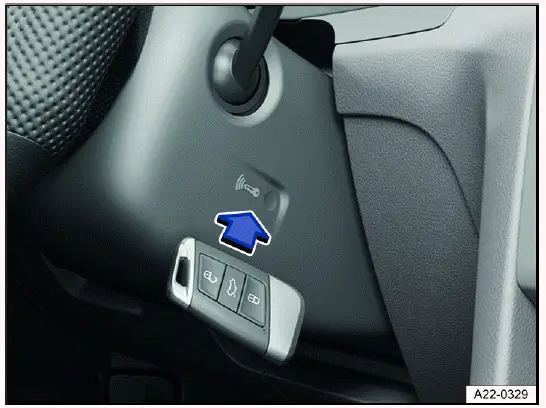
Fig. 93 On the right side of the steering column: emergency start function on vehicles with Keyless Access with push-button start.
A corresponding indicator appears in the instrument cluster display.
If the vehicle key has a weak or drained button cell battery, the vehicle key may not be able to be detected. Key recognition may also be affected if the key is inside a metal case, close to electronic devices, or shielded by other objects.
An emergency start must be performed:
1. Press and hold the brake pedal.
2. Hold the vehicle key on the right side of the steering column trim panel immediately after pressing the starter button fig. 93. Hold the key in the indicated area so the vehicle can read the key signal at close range.
The ignition will switch on automatically and the engine may start. If the engine starts, replace the key battery as soon as possible so normal Keyless Access operation can be restored.
The engine cannot be started
If an unauthorized vehicle key is used or the system is malfunctioning, a corresponding indicator appears in the instrument cluster display. The immobilizer may prevent the engine from starting if the key is not coded for the vehicle.
1. Use an authorized vehicle key. Make sure the correct key for this Volkswagen Taos is inside the cabin and is not being blocked by metal objects or electronic interference.
2. If the malfunction persists, contact an authorized Volkswagen dealer or authorized Volkswagen Service Facility.
The engine cannot be started
The engine cannot be started by briefly pressing the starter button while activating the brake pedal or the clutch pedal.
There is a malfunction in the start system.
1. Press the starter button until the engine starts. Keep the brake pedal pressed and do not press the accelerator pedal during the starting attempt.
2. Contact an authorized Volkswagen dealer or authorized Volkswagen Service Facility for assistance. A start system fault may involve the starter button, key recognition, brake pedal signal, immobilizer, or related control units.
The engine cannot be started remotely
If at least one of the following conditions are met, the engine remote start function does not start or the engine switches off when it was running. These conditions are designed to prevent unsafe or unintended remote operation:
- The vehicle is unlocked.
- The hood or the trunk lid is opened.
- The selector lever is not in position
 ⇒ Selector lever.
 - The brake or accelerator pedal is pressed.
- During the remote start the fuel level sinks to the reserve amount.
- If the 12-volt vehicle battery is too weak or discharged.
- The switch for the hazard warning lights is pressed.
Before attempting remote start again, check that the Volkswagen Taos is locked, the hood and trunk lid are fully closed, the transmission is in the correct position, and no warning condition is active. If remote start still does not work after all conditions are met, have the system checked by an authorized Volkswagen dealer or authorized Volkswagen Service Facility.
Stopping the engine
Stopping the engine
1. Bring the vehicle to a complete stop ⇒
 . Before switching off the engine, make sure the vehicle is no longer moving and that it is positioned safely away from traffic.
2. Park the vehicle. Select a safe parking location, secure the Volkswagen Taos properly, and make sure the vehicle cannot roll before leaving the driver seat.
3. Press the starter button briefly. If the engine cannot be turned off in the normal way, use the emergency stop function. Do not repeatedly press controls without checking the instrument cluster messages.
4. Pay attention to the messages in the instrument cluster. These messages may give important information about ignition status, vehicle readiness, parking lock, or a system condition that requires driver action.
WARNING
When the engine is switched off, certain vehicle systems do not work or only work in a limited way, such as the brake booster or power steering. As a result, you must use more force for steering and you must apply more pressure on the brake pedal to stop. When the vehicle is moving, this can result in loss of control of the vehicle, accidents and serious or fatal injuries.
- Never switch off the engine while the vehicle is in motion.
If the engine is switched off while driving, the Volkswagen Taos may become much harder to steer and stop. Even though basic mechanical steering and braking may still be possible, the effort required can increase suddenly, leaving the driver with less time and control in traffic.
WARNING
When the engine is switched off, the airbags and safety belt pretensioners will not function. This can cause serious or fatal injuries in the event of accidents.
- Never switch off the engine while the vehicle is in motion.
Safety systems are designed to work when the vehicle is in the proper operating state. Switching off the engine at the wrong time can reduce or deactivate protection functions that may be needed during an unexpected collision or emergency maneuver.
WARNING
The parts of the exhaust system become very hot and can ignite flammable materials, for example shrubs, leaves, dry grass or spilled fuel. This can lead to a fire and cause accidents and serious or fatal injuries.
- Never park the vehicle in such a way so that the exhaust system components come into contact with flammable materials under the vehicle.
- Never use additional undercoating or corrosion protection for exhaust pipes, catalytic converters, heat shields, or particulate filters.
After driving, the exhaust system can remain hot for a significant time. Avoid parking over dry vegetation, paper, plastic, fuel residue, or other materials that could ignite from contact with heated exhaust components under the vehicle.
WARNING
If you leave vehicle keys unattended in the vehicle, children or unauthorized people could lock the doors and/or the trunk lid, activate drive-ready mode and thereby activate electrical equipment, such as the power windows. This can cause accidents and serious or fatal injuries.
- Always take all vehicle keys with you if you are leaving the vehicle.
Before walking away from the Volkswagen Taos, confirm that the ignition is off, the vehicle is secured, and the key is with you. Leaving a valid key inside the cabin can allow unintended use of vehicle systems.
WARNING
If you leave children, people requiring assistance or animals unattended in the vehicle, they may accidentally set the vehicle in motion or be subjected to very high or low temperatures. There is a risk of accidents and serious or fatal injuries.
- Never leave children, people requiring assistance or animals unattended in the vehicle.
Cabin temperature can rise or fall quickly after the engine is switched off, and occupants who cannot leave the vehicle on their own may be placed in danger. Always check the seats and rear area before locking the vehicle.
NOTICE
The engine can overheat after turning it off if the vehicle is driven with a high engine load for a long period of time.
- Let the engine run in neutral for approximately two minutes before turning it off.
After demanding driving, such as climbing long grades, driving at high speed, towing where permitted, or operating in very hot weather, allowing the engine to idle briefly helps stabilize temperatures before shutdown. This can reduce heat stress on engine components.
 The radiator fan in the engine compartment may continue running for several minutes after turning the engine off, even if the ignition is switched off. The radiator fan turns off automatically.
This fan operation is normal and helps remove residual heat from the engine compartment. Keep hands, tools, clothing, and loose objects away from the fan area because the fan can operate after the Volkswagen Taos has been switched off.
Troubleshooting
The engine cannot be turned off
The engine cannot be turned off when the starter button is pressed briefly.
An emergency stop must be performed:
1. Press the starter button twice within several seconds or press and hold one time. Use this only when the normal shutdown procedure does not work.
The engine switches off automatically ⇒ Starter button. After the emergency stop, pay attention to any messages in the instrument cluster and have the system checked if the problem happens again.
Start/Stop system
Start-stop system
Function description
The start-stop system automatically switches the engine off shortly before the vehicle comes to a stop, when the vehicle is stationary, or when the driving situation allows the engine to pause safely. In the Volkswagen Taos, this function is designed to reduce unnecessary idling, help lower fuel consumption, and reduce emissions during everyday driving, especially in city traffic and at traffic lights.
The engine always restarts automatically when required for the vehicle or for the situation detected by the system. For example, the engine may restart to maintain cabin comfort, support electrical demand, respond to driver input, or prepare the vehicle to move again.
The function is automatically activated every time the ignition is switched on. If the driver wants to deactivate it for a specific drive, this must be done manually after starting the vehicle.
Indicator lights
Information about the current status is shown in the instrument cluster display. These indicators help the driver understand whether the start-stop system is currently active, unavailable, or has restarted the engine automatically.
When indicator light  comes on, the start-stop system is available and the automatic engine stop is active.
If the  indicator light is lit, the start-stop system is not available or the start-stop system has automatically started the engine. This does not always mean there is a malfunction; it may simply mean that one of the required operating conditions is not currently met.
Conditions for Automatically Restarting the Engine
- Vehicles with an automatic transmission: If you take your foot off the brake pedal or you press the accelerator pedal.
- Vehicles with manual transmission: if the clutch is operated.
- If the vehicle interior heats up or cools down significantly.
- If the vehicle starts to move.
- If the electrical voltage in the 12-volt vehicle battery falls.
- If the steering wheel is moved.
These automatic restart conditions help ensure that the Volkswagen Taos remains ready to drive and that comfort, steering support, and electrical systems continue to operate as needed. The restart may be noticeable as a brief engine start-up response before the vehicle begins moving again.
Conditions that Can Prevent Automatic Engine Shutdown
- The driver is not wearing their safety belt.
- The driver door is opened.
- The engine hood is open.
- A minimum engine temperature has not been reached.
- Vehicles with Climatronic: The temperature in the vehicle interior is not within the preset temperature values or the humidity is too high.
- The air conditioner's defrost function is switched on.
- The charge level of the 12 V vehicle battery is insufficient.
- The temperature of the 12 V vehicle battery is too low or too high.
- The vehicle is on a large uphill or downhill gradient.
- The steering wheel is significantly turned.
- The reverse gear is engaged.
If one or more of these conditions are present, the engine may continue running even when the vehicle is stopped. This is normal system behavior and helps protect drivability, battery charge, climate comfort, and safety-related functions.
If the conditions for automatic engine switch-off are only achieved during a stationary phase, then the engine may also switch off at this point, e.g. if the defrost function is switched off. The system continuously evaluates the vehicle state, so the engine stop may occur later than expected if the required conditions become suitable after the vehicle has already stopped.
Manually deactivating and activating the start-stop system
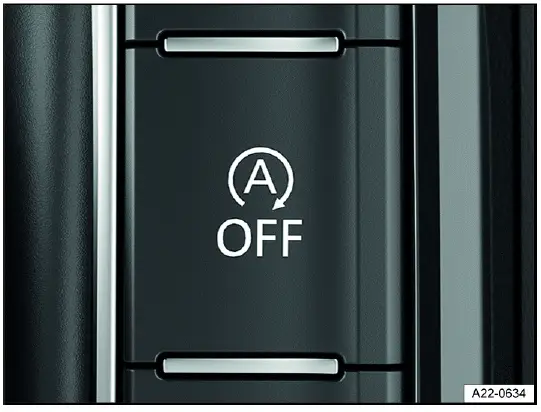
Fig. 94 In the lower section of the center console or, depending on the vehicle equipment, in the Infotainment system: Button for the start-stop system.
Manually deactivating the start-stop system:
1. Press the  button in the center console. When the start-stop system is deactivated, the indicator light on the button comes on fig. 94. This confirms that the automatic engine stop function has been switched off for the current driving cycle.
 Always manually deactivate the start-stop system when driving through water.
Deactivating the system before driving through water helps prevent the engine from shutting off at an unsuitable moment. This is especially important when the vehicle must keep moving steadily through a flooded or wet section of road.
Manually activating the start-stop system:
1. Press the  button in the center console again fig. 94.
Each time you press the  button, the instrument cluster display will show the status of the start-stop system. This allows the driver to confirm whether the system is active or deactivated.
If the start-stop system has switched the engine off, it restarts as soon as the system is deactivated by pressing the  button. In the Volkswagen Taos, this restart is part of normal system operation and prepares the vehicle for immediate driving.
Use the start-stop system according to the driving situation. It can be helpful in urban traffic, but the driver may choose to deactivate it temporarily when steady engine operation is preferred, such as during certain maneuvering situations, water crossings, or repeated short stops.
 In some cases, you may need to restart the engine manually, for example if the hood or the driver door is opened while the start-stop system is active. Pay attention to the relevant message on the instrument cluster display ⇒
 .
.
If the system requests a manual restart, follow the message in the display and start the engine using the normal starting procedure. In the Volkswagen Taos, this behavior is intended to prevent unexpected automatic engine operation when certain safety-related conditions have changed.
Start/stop mode with Adaptive Cruise Control (ACC)
After an active brake intervention by the Adaptive Cruise Control (ACC), the engine is switched off until the vehicle is stationary. This can happen in stop-and-go traffic when ACC slows the vehicle to a halt and the start-stop system determines that an engine stop is possible.
In the following cases, if the ACC is active, the engine is restarted:
- The accelerator pedal is pressed.
- If ACC has resumed the speed and distance control.
- The vehicle in front has moved on.
The engine is restarted if the Adaptive Cruise Control (ACC) is deactivated and the vehicle in front has moved on. The driver should still remain attentive, keep control of the vehicle, and be ready to brake or accelerate as traffic conditions change.
 If the temperature is above approx. 38 ºC (100 ºF), the engine stop function may be automatically deactivated.
At very high outside temperatures, the Volkswagen Taos may keep the engine running to support cooling performance, protect the 12 V vehicle battery, and maintain cabin comfort. This is normal system behavior and does not necessarily indicate a malfunction.
 For case of vehicles with Driving Mode Selection, the start-stop system is automatically activated if the Eco driving mode is selected.
Eco mode is designed to support efficient driving, so automatic engine stop may be used more readily when the required operating conditions are met. If steady engine operation is preferred for a specific situation, the driver can manually deactivate the start-stop system.
WARNING
If the start-stop system is activated during work in the engine compartment, the motor may start suddenly. This can cause accidents and serious injuries.
- Always deactivate the start-stop system when working in the engine compartment.
Before opening the hood or performing any check near moving engine components, make sure the engine is switched off and cannot restart automatically. Keep hands, tools, clothing, and loose objects away from the engine compartment until the vehicle is fully secured.
WARNING
When the engine is switched off, certain vehicle systems do not work or only work in a limited way, such as the brake booster or power steering. As a result, you must use more force for steering and you must apply more pressure on the brake pedal to stop. When the vehicle is moving, this can result in loss of control of the vehicle, accidents and serious or fatal injuries.
- Never switch off the engine while the vehicle is in motion.
Even though the start-stop system manages engine shutdown only under suitable conditions, the driver must never switch off the engine manually while driving. Loss of assistance can make the vehicle harder to steer and stop, especially during emergency maneuvers.
WARNING
When the engine is switched off, the airbags and safety belt pretensioners will not function. This can cause serious or fatal injuries in the event of accidents.
- Never switch off the engine while the vehicle is in motion.
Safety systems are designed to operate when the vehicle is in the correct driving-ready state. Switching off the engine or ignition at the wrong time can reduce the protection available during a collision.
WARNING
If the ignition is switched off, the steering lock can engage and you would no longer be able to steer the vehicle. When the vehicle is moving, this can result in loss of control of the vehicle, accidents, and serious or fatal injuries.
- Never switch off the ignition when the vehicle is in motion.
Always keep the Volkswagen Taos in a proper operating state while the vehicle is moving. If a warning message appears, slow down safely, follow the instrument cluster instructions, and stop only when it is safe to do so.
NOTICE
If the start-stop system is used for a very long period of time at very high outside temperatures, this can damage the 12-volt vehicle battery.
- Avoid using the start-stop system at very high outside temperatures.
High heat places additional demand on the battery and climate control system. When the outside temperature is extreme, manually deactivating start-stop may help maintain more stable cooling and reduce unnecessary stress on the electrical system.
Troubleshooting
The engine does not start automatically
1. Start the engine manually ⇒ Start the engine.
2. Manually deactivate the start-stop system ⇒ Start-stop system.
3. Contact an authorized Volkswagen dealer or authorized Volkswagen Service Facility to have the system inspected.
Volkswagen recommends contacting an authorized Volkswagen dealer or authorized Volkswagen Service Facility.
If the engine does not restart automatically, do not continue relying on the start-stop function until the cause has been checked. A weak 12 V battery, open hood, driver door status, sensor fault, or system condition may prevent automatic restart in the Volkswagen Taos.
Automatic transmission
Selector lever
When the ignition is switched on, the engaged selector lever position is shown in the instrument cluster display.
Selecting a selector lever position
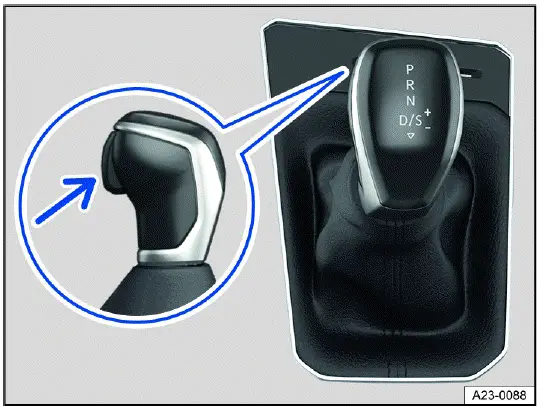
Fig. 95 In the center console: selector lever of the automatic transmission (general example).
To change into gear from neutral position
 , proceed as follows:
1. Start the engine.
2. Press the brake pedal. Keep the vehicle held firmly with the brake before selecting a driving position.
3. Push the selector lever into the desired selector lever position fig. 95. In the Volkswagen Taos, the selected position is shown in the instrument cluster so the driver can confirm the transmission status before moving off.
Description of the selector lever positions
 The drive gears are locked. Only select this gear when the vehicle is stationary.
To move the selector lever out of this position when the ignition is switched on, press the brake pedal and press the lock button on the selector lever. This prevents the vehicle from being shifted out of the parking lock unintentionally.
 Reverse gear is selected. Only select this gear when the vehicle is stationary.
 The transmission is in the neutral setting. No power is transferred to the wheels and the engine braking effect is not available.
 gear: normal program.
The transmission upshifts and downshifts automatically when in the forward driving gears. The shifting time depends on the engine load, the personal driving style, and the driving speed. Normal drive mode is intended for everyday driving, balancing smooth acceleration, fuel efficiency, and relaxed gear changes.
 gear: sport program.
The forward gears automatically upshift later and downshift earlier than in
 gear in order to fully utilize the engine power reserves. The shifting time depends on the engine load, the personal driving style, and the driving speed. Sport mode can make the Volkswagen Taos feel more responsive because the transmission holds lower gears longer and reacts more quickly to acceleration requests.
To switch between gears
 and
and
 , tap the selector lever toward the rear
 .
.
The selector lever will always spring back to the selector lever position
 . This also applies when in the tiptronic shift gate ⇒ Shifting using tiptronic. The physical lever position returns, while the selected transmission mode is confirmed through the display.
Selector lever lock
The selector lever lock prevents you from selecting a gear accidentally when in the
 or
or
 position, causing the vehicle to roll.
To release the selector lever lock, switch the ignition on and press the brake pedal. Then press the lock button on the selector lever handle fig. 95 (arrow). This deliberate sequence helps prevent unintended movement when the engine is running or the vehicle is ready to drive.
When skipping past the
 position, for example by switching from reverse gear to
 , the selector lever is not locked. This makes it possible to free the vehicle when it is stuck by "rocking" it. If the lever remains in the
 position for more than approx.
1 second when the vehicle is traveling at a speed lower than approx. 5 km/h (approx. 3 mph) and the brake pedal has not been pressed, the selector lever lock will engage ⇒
 .
.
Use rocking movements only carefully and only when traction conditions require it, such as when the vehicle is stuck in snow, mud, or loose ground. Avoid excessive acceleration because spinning wheels can reduce control and place unnecessary stress on the transmission.
WARNING
If the brake pedal is released while the engine is running and gear
 or
or
 is engaged, the vehicle will start moving. This can cause unintentional vehicle movement and accidents and serious injuries.
- When the engine is running and the
 or
or
 gear is engaged, hold the vehicle with the brake pedal.
 - As the driver, never leave the driver seat when the engine is running and a gear is engaged.
- If you have to leave the vehicle while the engine is running, always set the electronic parking brake and move the selector lever to the
 position.
Automatic transmissions can transfer driving force as soon as a gear is engaged, even without pressing the accelerator. Always keep the Volkswagen Taos controlled with the brake pedal until you are ready to move.
WARNING
Engaging the incorrect gear can cause you to lose control of the vehicle, which could lead to accidents and serious injuries.
- Never press the accelerator pedal when engaging a gear.
- Never shift into reverse gear
 or engage the parking lock
 while the vehicle is moving.
Selecting the wrong position while the vehicle is moving can damage the transmission and may cause an abrupt change in vehicle behavior. Before changing from a forward gear to reverse, or from reverse to a forward gear, bring the vehicle to a complete stop.
WARNING
If the vehicle is left in selector lever position
 on inclines, the vehicle will roll downhill even if the engine is switched on.
- This can cause accidents and serious injuries.
- Never leave the vehicle in selector lever position
 .
.
Neutral does not hold the vehicle in place. When stopping on an incline, use the brake pedal, set the electronic parking brake when needed, and select the correct parking position before leaving the driver seat.
NOTICE
If the electronic parking brake is not switched on while the vehicle is stationary and the brake pedal is released while the parking lock
 is engaged, the vehicle may move forward or backward a few centimeters. This can cause damage to the vehicle.
- Always set the electronic parking brake first before releasing the brake pedal.
On slopes, parking loads can rest on the transmission parking mechanism if the electronic parking brake is not used first. Setting the parking brake before releasing the brake pedal helps secure the vehicle more smoothly and reduces stress on the parking lock.
 If is engaged by mistake while driving, take your foot off the accelerator pedal. Wait until the engine is at idle speed in neutral before shifting into a drive gear.
If neutral is selected accidentally, do not accelerate. Let the engine speed settle, then select the proper drive position only when it is safe to do so and the vehicle can be controlled smoothly.
 If the selector lever is left for a long period of time in any position other than in the parking lock
 when the engine is switched off, the 12 V vehicle battery will drain.
Before leaving the Volkswagen Taos parked, confirm that the parking lock is engaged, the electronic parking brake is set, and the ignition is switched off. This helps prevent unintended movement and avoids unnecessary battery discharge.
Shifting using tiptronic
The tiptronic mode allows you to shift gears manually on an automatic transmission.
When shifting in the tiptronic program, the gear currently engaged is maintained until the system needs to intervene because of the current driving situation. In the Volkswagen Taos, tiptronic gives the driver more direct control over gear selection while still protecting the engine and transmission from unsuitable shift commands.
Using tiptronic with the selector lever
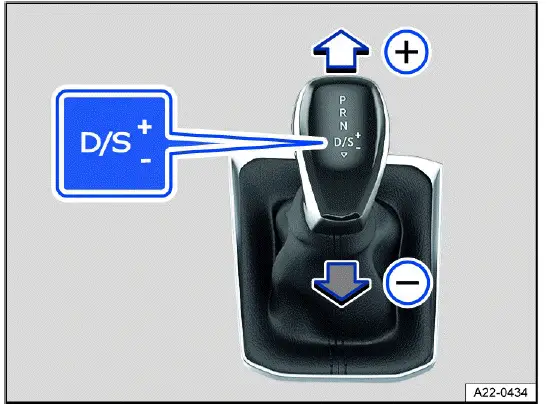
Fig. 96 In the center console: selector lever in the tiptronic position.
1. Push the selector lever to the right out of the
 selector lever position and into the tiptronic shift gate. This changes the transmission from fully automatic operation to manual shift selection.
2. Tap the selector lever forward
 or to the rear
 to upshift or downshift fig. 96. Use an upshift for smoother, lower-rpm driving and a downshift when stronger engine braking or quicker response is needed.
The lock button on the selector lever must not be pressed when tapping the selector lever within the tiptronic shift gate. Only light forward or rearward movements are needed to request a gear change.
Operating Tiptronic with the shift paddles
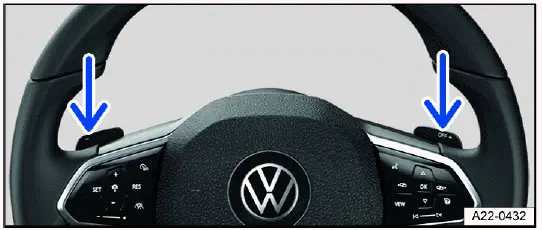
Fig. 97 Behind the steering wheel: shift paddles for the tiptronic.
1. Pull the right shift paddle toward the steering wheel to shift up fig. 97. This can be useful when you want to reduce engine speed after acceleration or maintain a calmer driving feel.
2. Pull the left shift paddle toward the steering wheel to shift down. Downshifting can provide stronger engine braking on descents or quicker response before acceleration, as long as the selected gear is suitable for the current speed.
3. Pull the right shift paddle toward the steering wheel for about a second to leave the tiptronic program. The transmission then returns to normal automatic shifting, depending on the selector lever position and driving conditions.
The Tiptronic program ends automatically if you do not operate the shift paddles for some time and the selector lever is not in the Tiptronic gate. This allows the Volkswagen Taos to return to automatic gear selection when manual input is no longer being used.
 When accelerating, the transmission automatically upshifts to the next gear shortly before the maximum permissible engine RPM is reached.
This protective upshift helps prevent the engine from exceeding its safe operating speed, even if the driver remains in the tiptronic program.
 When downshifting manually, the transmission only shifts if it is no longer possible to over-rev the engine.
If a downshift request would make engine speed too high, the transmission will delay or refuse the shift. This helps protect the engine and keeps the drivetrain operating within a safe range.
Driving with an automatic transmission
The transmission shifts up and down automatically when in the forward driving gears.
In normal automatic driving, the transmission chooses gears according to speed, load, accelerator input, and driving conditions. The driver can still use tiptronic when more control is helpful, such as on hills, during overtaking preparation, or when additional engine braking is needed.
Driving on an incline
The steeper the incline, the lower the gear that you should select. Lower gears increase the engine braking effect and help reduce continuous load on the service brakes. Never let the vehicle roll down mountains or hills in the
 neutral setting.
1. Reduce your speed before the descent becomes steep.
2. Push the selector lever to the right out of the
 selector lever position and into the tiptronic shift gate.
3. Tap the selector lever back to downshift. Select a gear that allows the Volkswagen Taos to maintain a controlled speed without constant braking.
Or: Downshift using the shift paddles on the steering wheel. The paddles allow quick gear changes while keeping both hands close to the steering wheel.
Stopping and starting to drive uphill
The steeper the hill, the lower the gear that you should select. A lower gear can help the vehicle pull away more confidently and can reduce unnecessary transmission shifting on steep gradients.
If you stop on a hill with a gear selected, always press the brake pedal or set the electronic parking brake to prevent the vehicle from rolling away. Only release the brake pedal or the electronic parking brake once you start driving ⇒
 .
.
Do not hold the vehicle on an incline by pressing the accelerator pedal. Use the brake system or electronic parking brake instead, then accelerate smoothly when it is safe to move.
Coasting with a DSG automated transmission
When coasting, the vehicle's momentum is used to save fuel with predictive driving. The engine does not slow down the vehicle, so it can roll for a longer period. The function is only available in selector lever position
 and within a speed range of approx. 40 to 130 km/h (25 mph to 80 mph).
If the brake is engaged while rolling, the engine will remain switched off until the vehicle comes to a complete stop. This behavior is part of the efficiency strategy and depends on the current driving conditions.
When rolling without braking, the engine starts again automatically when the vehicle reaches "creeping pace". This ensures that the vehicle can continue moving smoothly at low speed.
The engine may restart automatically to ensure the engine restarts safely and there is a secure supply of electricity to the vehicle electrical system. In the Volkswagen Taos, this restart can happen even if the driver has not pressed the accelerator, because the system must maintain reliable vehicle operation.
Triggering the coasting feature
1. In the driving mode selection, select the Eco driving mode. Eco mode supports efficient driving and may allow the coasting function when all required conditions are met.
2. Take your foot off the accelerator. The engine is disengaged and in neutral. The vehicle is rolling without any engine braking effect.
Use coasting only when traffic, road, and visibility conditions allow it. Because engine braking is reduced during coasting, the driver must be ready to brake or accelerate at any time to maintain safe control of the vehicle.
Cancelling coasting
1. Press the brake pedal firmly. This immediately restores driver control through braking and ends the coasting phase.
Or: Press the accelerator pedal or brake pedal briefly. A short input is enough for the system to reconnect the drivetrain and return the Volkswagen Taos to normal driving response.
Or: Pull a shift paddle towards the steering wheel. Manual shift input tells the transmission that the driver wants direct control instead of continued coasting.
Or: Push the selector lever into the tiptronic position. This also cancels coasting because the transmission changes from efficiency-focused rolling to manual gear selection.
Or: Change driving modes from Eco. Since coasting is linked to efficient driving behavior, selecting another driving mode can end the function and restore a more conventional engine braking feel.
Kick-down
The kick-down function makes maximum acceleration possible in selector lever position
 or in the tiptronic position.
When you press the accelerator pedal all the way down, the automatic transmission downshifts into a lower gear, depending on the vehicle speed and engine RPM. This allows the engine to use its available power more effectively and gives the vehicle the strongest possible acceleration for the current driving situation ⇒
 .
.
With the kick-down function, the automatic upshift to the next gear only occurs if the maximum predefined engine RPM is reached. This means the transmission may hold a lower gear longer than usual to deliver stronger acceleration.
For vehicles with driving mode selection, if the Eco driving mode is selected and the accelerator pedal is fully depressed past the pressure point, the engine power is controlled automatically so that the Volkswagen Taos achieves maximum acceleration. This allows the driver to request full power even when an efficiency-oriented driving mode is active.
Use kick-down only when a quick acceleration maneuver is necessary, such as merging into faster traffic or overtaking when conditions are clear. Sudden full-throttle acceleration can change vehicle balance, reduce traction, and surprise other road users if used carelessly.
Launch Control Program
Depending on the vehicle equipment, vehicles with automatic transmission have a Launch Control Program. The Launch Control Program provides maximum acceleration from a standstill by coordinating engine speed, transmission response, and traction behavior for a rapid start.
1. Switch off ASR.
2. Use your left foot to press down on the brake pedal and hold it. Keep the vehicle fully stationary before applying accelerator input.
3. Move the selector lever to selector lever position
 in gear
 or to the tiptronic position.
Or: on vehicles with Driving Mode Selection, select the Sport or Race driving mode. These modes prepare the transmission and engine response for more dynamic acceleration.
4. Use your right foot to press the accelerator pedal until an engine speed of approx. 3200 rpm is reached. Maintain firm brake pressure with your left foot until you are ready to start.
5. Take your left foot off the brake ⇒
 . The vehicle starts with maximum acceleration.
6. Reactivate ASR after acceleration. Traction control should be switched back on for normal driving so the Volkswagen Taos can provide its standard stability and traction support.
Launch Control places heavy demand on tires, transmission components, engine mounts, and the driveline. It should be used only where it is legal, safe, and appropriate, and never in traffic situations where sudden acceleration could endanger others.
WARNING
Fast acceleration or switching off the ASR can cause traction loss and sliding. This could cause loss of vehicle control, accidents, and serious or fatal injuries, especially on slippery roads, such as on wet, icy or dirty roads.
- Always adapt your driving style to the flow of traffic.
- Only use the kick-down function, Launch Control Program or accelerate quickly when the visibility, weather, road, and traffic conditions allow it, and when other road users will not be endangered by the vehicle's acceleration and driving style.
- Switch the ASR back on after acceleration.
Strong acceleration can quickly exceed available grip, especially if the road surface is wet, dusty, uneven, icy, or covered with loose gravel. Even with driver assistance systems, the driver remains responsible for judging whether rapid acceleration is safe.
WARNING
Prolonged braking causes the brakes to overheat. This can considerably reduce braking performance, considerably increase braking distance and possibly lead to a total brake system malfunction. Accidents and serious or fatal injuries could result.
- Never let the brakes "rub" too often and too long or press the brake pedal too often and too long.
On long downhill sections, use a suitable gear or tiptronic downshifting to support engine braking instead of relying only on continuous brake pressure. This helps reduce heat buildup and keeps braking performance more consistent.
NOTICE
If the vehicle rolls with the engine switched off, the transmission is not lubricated. This can cause the automatic transmission to overheat and can damage it.
- If you stop on inclines when a gear is engaged, do not press the accelerator pedal to prevent the vehicle from rolling away.
- Never let the vehicle roll in the
 selector lever position, especially when the engine is stopped.
Holding the vehicle on a hill with the accelerator can overheat and strain transmission components. Use the brake pedal or electronic parking brake to hold the Volkswagen Taos in place, then accelerate smoothly when you are ready to move.
NOTICE
Vehicles with the Launch Control Program: All vehicle components are put under intense strain when accelerating with the Launch Control Program. This can cause increased wear.
- Only use this function if the vehicle is at operating temperature.
Using Launch Control when the engine, transmission, tires, or driveline are cold can increase mechanical stress. Allow the vehicle to reach normal operating temperature before using performance-oriented functions.
NOTICE
If the brake pads "rub" when the brake pedal is pressed lightly, wear is increased.
- Never let the brakes "rub" by pressing the pedal lightly when braking is not really necessary.
Light, continuous brake pressure can create unnecessary heat and wear without providing effective speed control. Brake deliberately when needed, then release the pedal when braking is no longer required.
Troubleshooting
 The engine is not starting
The green indicator light turns on.
The brake pedal was not pressed, for example when trying to shift to another gear using the selector lever. In the Volkswagen Taos, the transmission and start system require a clear brake pedal signal before certain gear selections or starting actions are allowed.
1. Press the brake pedal to select a gear. Keep the brake pedal pressed firmly until the desired selector lever position is engaged and the vehicle is ready to move in a controlled way.
 Driving is restricted by the lock button
The green indicator light blinks.
The lock button in the selector lever is not engaged. If the lock button does not return or engage correctly, the transmission may prevent normal driving to avoid an unintended gear selection.
1. Check if the lock button is locked.
2. Lock the lock button into place if necessary. If the button feels stuck, loose, or does not operate normally, do not force the selector lever; have the mechanism inspected by a qualified professional.
 Driving is restricted by the selector lever lock
The green indicator light blinks. A message is also displayed.
In rare cases, the Automatic Shift Lock (ASL) may not lock in vehicles with a DSG automated transmission. This can happen when the system does not receive the expected brake, selector lever, or locking signal.
The engine will then be disabled to prevent the vehicle from going into motion unintentionally. This protective behavior helps reduce the risk of the Volkswagen Taos moving without the driver clearly selecting a safe driving condition.
1. Press and release the brake pedal again. Then try selecting the desired position carefully while watching the message in the instrument cluster.
 Transmission overheating
The yellow indicator light turns on.
An audible warning may also sound. Where applicable, a message will appear in the instrument cluster display.
The DSG automated transmission can become too hot, for example due to frequently starting up on slopes, holding the vehicle with the accelerator, repeated low-speed maneuvering, or driving slowly under heavy load.
1. At the next opportunity, stop and let the transmission cool down with the parking lock
 engaged and the engine running ⇒
 .
.
2. If the indicator light does not turn off, do not continue driving.
3. Contact an authorized Volkswagen dealer or authorized Volkswagen Service Facility for assistance. Otherwise, the transmission could become severely damaged.
If a yellow overheating warning appears, avoid repeated stop-and-go starts, steep hill starts, and creeping forward at walking speed. Give the transmission time to cool before continuing, especially if the Volkswagen Taos has been driven in traffic, on an incline, or in hot weather.
 Transmission overheating
The red warning light turns on.
An audible warning may also sound. Where applicable, a message will appear in the instrument cluster display.
The DSG automated transmission can become too hot, for example due to frequently starting up on slopes. A red warning means the condition is more serious than a yellow advisory and requires immediate attention.
 Do not continue driving!
1. Let the transmission cool down with the parking lock
 engaged and the engine running ⇒
 .
.
2. If the warning light stays on, stop driving.
3. Contact an authorized Volkswagen dealer or authorized Volkswagen Service Facility for assistance. Otherwise, the transmission could become severely damaged.
Do not try to continue driving through a red transmission overheating warning. Continuing to move the vehicle may increase internal temperature, accelerate wear, and damage transmission components that rely on controlled lubrication and cooling.
Selector lever lock emergency release
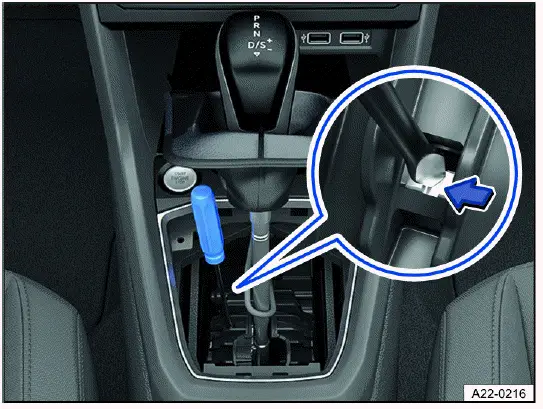
Fig. 98 In the center console: manually release the Automatic Shift Lock (ASL) (variant 1).
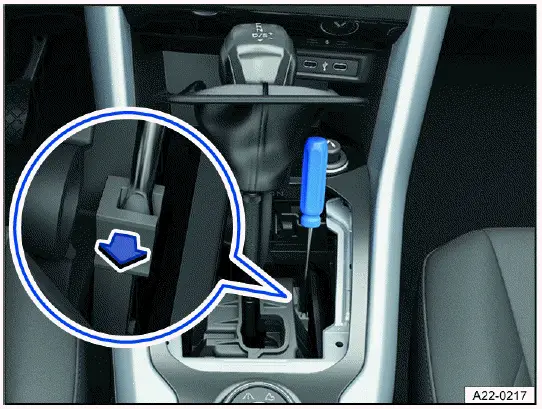
Fig. 99 In the center console: manually release the Automatic Shift Lock (ASL) (variant 2).
If there is a loss of power, for example due to the 12 V vehicle battery being drained, and the vehicle should be towed, then the selector lever lock must be released manually. Contact an authorized Volkswagen dealer or authorized Volkswagen Service Facility for assistance.
The emergency release is located under the shift gate cover. This release is intended for exceptional situations, such as preparing the vehicle for towing when normal selector lever operation is not possible.
Remove the cover on the shift gate:
1. Set the electronic parking brake. If you cannot set the electronic parking brake, the vehicle must be secured another way to prevent it from rolling. Use wheel chocks or another suitable securing method before releasing any transmission lock.
2. Switch the ignition off.
3. Pull the cover near the selector lever boot upward carefully with the wires connected fig. 98 or fig. 99. Do not pull sharply, because wiring for selector lever illumination or related controls may still be attached.
4. Fold the cover upward over the selector lever. Place it so that the connected wires are not stretched, pinched, or twisted.
Manually release the selector lever lock:
1. Press the release lever in the direction of the fig. 98 or fig. 99 arrow and hold in this position.
2. Press the lock button forward into the selector lever handle and move the selector lever to the
 position.
3. After releasing the cover manually, carefully press into the center console while making sure the wires are in the correct position. The cover should sit evenly without trapping any wiring underneath.
Only use the emergency release when necessary. If the Volkswagen Taos must be moved or towed after a power loss, make sure the vehicle is secured against rolling and follow the proper towing instructions for the transmission type.
Emergency program
If all of the selector lever position displays have a gray background on the instrument cluster display, this means there is a system malfunction. The DSG automated transmission runs in emergency mode. The vehicle can still be driven in emergency mode, but only at a reduced speed and not in all gears.
With the DSG automated transmission, it may no longer be possible to drive in reverse gear in some cases. Acceleration may also be limited, gear changes may feel different, and the transmission may select only certain gears to protect itself from further damage.
In all cases, have the DSG automated transmission checked immediately by suitably qualified professionals. Volkswagen recommends contacting an authorized Volkswagen dealer or authorized Volkswagen Service Facility.
Vehicle is not moving even when a drive gear is engaged
If the vehicle does not move in the desired direction, the system may not have engaged the drive position correctly. This can occur if the selector lever input, brake pedal signal, transmission control, or drive readiness state is not recognized as expected.
1. Press the brake pedal and select the drive position again. Confirm the selected position in the instrument cluster before attempting to move.
2. If the vehicle still does not move in the desired direction, there is a system malfunction. See an authorized Volkswagen dealer or authorized Volkswagen Service Facility for assistance to have the system checked.
Do not press the accelerator repeatedly if the Volkswagen Taos does not move as expected. Repeated throttle input can increase transmission load and may make the fault condition worse.
WARNING
If the parking lock
 is released and the electronic parking brake is switched off, the vehicle may start to move unexpectedly on inclines or hills. This can cause accidents and serious injuries.
- Never release the parking lock
 once the electronic parking brake is switched off.
Before releasing the parking lock manually, always secure the vehicle. On a slope, even a small amount of movement can quickly become uncontrollable if the parking brake is not applied or the wheels are not secured.
NOTICE
If the vehicle rolls with the engine off and the selector lever in position
 for a long period of time or at high speed, the DSG automated transmission will be damaged.
- Do not allow the vehicle to roll for a long period of time or at high speed with the engine off and in the
 gear, e.g. in the case of towing.
The transmission requires proper lubrication and operating conditions. Rolling for too long or too fast with the engine off can prevent correct lubrication and cause internal heat buildup or mechanical damage.
NOTICE
If the transmission gets too hot or overheats, this may lead to increased wear or damage to the component.
- Drive faster than approx. 20 km/h (approx. 12 mph) or immediately stop the vehicle safely the first time the vehicle indicates that the transmission is overheating.
- Stop the vehicle safely as soon as possible and switch off the engine if the message and audible warning are repeating approximately every 10 seconds.
- Let the transmission cool down.
- Only start driving again when the audible warning is no longer sounding.
- Avoid starting the vehicle and driving slowly, like at walking speed, while the transmission is overheated.
Transmission overheating is often made worse by repeated creeping, hill starts, stop-and-go traffic, or holding the vehicle with the accelerator instead of the brake. If the warning appears, change driving behavior immediately and allow the system to cool before continuing.
Driving on slopes
Hill start assist
Hill start assist supports the driver when pulling away on an uphill grade by briefly holding the vehicle in place after the brake pedal is released.
Functional requirements
Hill start assist in the Volkswagen Taos is designed to make uphill starts smoother and more controlled, especially when the vehicle is stopped on an incline and the driver needs a moment to move from the brake pedal to the accelerator pedal. The system does not replace careful driving, but it can help reduce the chance of the vehicle rolling backward during a normal hill start.
The following requirements must be met at the same time:
- The Volkswagen Taos must be stationary and held in position with the brake pedal until you are ready to drive away.
- The engine must be running smoothly and evenly, without signs of stalling, misfiring, or another operating fault.
- A suitable gear or driving position must be selected for moving uphill, so the drivetrain is ready to transfer power as soon as acceleration begins.
To start driving, release the brake pedal and press the accelerator pedal immediately. As the vehicle begins to move, the brake pressure is reduced gradually, allowing the vehicle to pull away in a controlled manner instead of releasing all holding force at once.
 The holding function of Hill Start Assist remains active only for a short time. Drive off within approximately two seconds after releasing the brake pedal.
This short holding period is intended only to support the transition between braking and acceleration. It is not meant to keep the vehicle parked on a hill or to hold it for an extended time in traffic. If more time is needed before moving away, keep the brake pedal pressed or use the electronic parking brake where appropriate.
When is it active?
Hill Start Assist is immediately deactivated if one of the conditions listed below is no longer met. When the function switches off, the vehicle may no longer be held automatically, so the driver must be ready to brake or secure the vehicle manually.
- The driver's door is opened while the vehicle is stopped.
- The engine begins running unevenly, or an engine fault is detected.
- The engine is switched off or stalls while the vehicle is on the incline.
- The selector lever is moved to the neutral position
 .
.
CAUTION
After the brake pedal is released, the vehicle will only be held briefly. If you hesitate too long before accelerating, it may roll backward, particularly on a steeper incline or when the vehicle is heavily loaded. This can lead to contact with traffic behind you, nearby objects, curbs, walls, or other obstacles.
- If the Volkswagen Taos starts to move backward, press the brake pedal at once or apply the electronic parking brake to bring the vehicle under control.
- In slow uphill traffic, keep steady pressure on the brake pedal until you are ready to move. Before pulling away, check the distance behind the vehicle and accelerate smoothly without delay.
Downhill speed control
Downhill speed control assists the driver when traveling down slopes by helping the vehicle use a suitable transmission strategy for controlled downhill driving.
System function
On Volkswagen Taos models equipped with the DSG automated transmission, the transmission can select an appropriate gear automatically based on the current road gradient, vehicle speed, and driving situation. The purpose is to make use of engine braking where possible and help reduce unnecessary load on the service brakes during downhill travel.
The selector lever must be in the
 selector lever position. Downhill speed control is not active in Tiptronic mode.
Because downhill speed control can only downshift as far as third gear, the driver may need to switch to Tiptronic mode on very steep descents. In Tiptronic mode, manually selecting second or first gear can increase engine braking, help maintain a lower speed, and reduce heat buildup in the brake system. This is especially useful on long downhill roads, mountain routes, or repeated descents where constant braking could reduce brake effectiveness.
While downhill speed control is active, the start-stop system is automatically deactivated. This helps keep the engine running continuously so the drivetrain and engine braking remain available while descending a slope.
Automatically activating downhill speed control
Downhill speed control may activate automatically when the road and vehicle conditions indicate that additional support is useful. The Volkswagen Taos uses several inputs to determine whether the function should intervene, including gradient, transmission position, speed, brake use, and the status of driver assistance systems such as CCS or ACC.
- If the gradient is greater than approximately 6%.
- And: if the selector lever is in the
 selector lever
position.
selector lever
position. - In addition, if the cruise control system (CCS) is switched off: if the speed is slower than approximately 80 km/h, or approximately 50 mph.
Or: The brake pedal is pressed.
- If the cruise control system (CCS) is also active: if the saved speed is exceeded.
- In addition, if Adaptive Cruise Control (ACC) is switched off: if the speed is slower than approximately 80 km/h, or approximately 50 mph.
Or: The brake pedal is pressed.
- If Adaptive Cruise Control (ACC) is also active: if the saved speed is exceeded.
Downhill speed control deactivates automatically
The function switches off automatically when the system determines that additional downhill support is no longer needed or when operating limits are reached. Even when the system deactivates smoothly, the driver must continue monitoring the vehicle speed and road surface.
- When the gradient decreases and the slope no longer requires assistance.
- If the transmission upshifts because the engine speed is greater than approximately 4500 rpm.
- If the cruise control system (CCS) is also active: if the saved speed can be maintained without additional downhill control.
- If Adaptive Cruise Control (ACC) is also active: if the saved speed can be maintained without additional downhill control.
WARNING
Downhill speed control can support downhill driving, but it cannot judge the road as a driver can. The system may not recognize every change in gradient, traction, traffic flow, or surface condition, and its response may be delayed or different from what the driver expects. Relying on it too heavily can allow the vehicle to gain speed or move in an unintended way, which may result in a serious accident.
- Keep full attention on the road and treat the system only as assistance. Steering, braking, speed choice, and vehicle control remain the driver's responsibility at all times.
- Do not assume the system can hold the vehicle on an incline or slow it sufficiently on every descent, especially on wet pavement, gravel, snow, ice, or other low-traction surfaces.
- Be prepared to brake immediately if the downhill grade becomes steeper, if traffic slows ahead, or if the tires begin to lose grip.
- Apply the brakes manually if the vehicle continues to gain speed despite downhill speed control.
- Choose a speed that matches visibility, weather, road surface, traffic density, and the steepness of the slope before the descent becomes difficult to control.
Used correctly, Hill Start Assist and downhill speed control can make driving this model on slopes more comfortable and predictable. However, both features are support systems only. The driver must still judge the incline, traffic conditions, available traction, and braking distance before starting uphill or descending a hill.
Hill Descent Control
Hill Descent Control helps the driver maintain better control when traveling down steep slopes.
System function
Hill Descent Control in the Volkswagen Taos is designed to assist the driver during controlled downhill driving, both when moving forward and when reversing on a steep incline. The system works by applying automatic braking interventions to individual wheels as needed, helping the vehicle maintain a low and steady speed without requiring constant brake pedal pressure from the driver.
The Anti-Lock Brake System (ABS) remains active while Hill Descent Control is operating. This helps prevent the wheels from locking, allowing the tires to keep rotating and maintain steering response as much as the road surface permits. The system is especially useful on loose gravel, dirt roads, uneven driveways, steep ramps, or other low-speed downhill sections where controlled movement is more important than quick acceleration.
When starting to drive downhill at speeds below 30 km/h, or approximately 19 mph, the system can regulate the speed within a low-speed range. The minimum regulated speed is approximately 2 km/h, or about 1 mph, and the maximum regulated speed is approximately 30 km/h, or about 19 mph. Within these limits, the driver can adjust the speed by pressing the accelerator pedal or the brake pedal.
For example, pressing the accelerator can allow the vehicle to descend slightly faster, while pressing the brake pedal can reduce the speed. Once the pedals are released and the conditions are still suitable, Hill Descent Control may continue helping the Volkswagen Taos maintain a controlled downhill pace.
However, enough traction must be available between the tires and the road surface. Hill Descent Control cannot overcome the limits of grip. If the hill is icy, greasy, muddy, covered with wet leaves, or made slippery by loose material, the vehicle may still slide or move faster than expected even while the system is active.
Displays
Depending on the driving situation, one of the following indicator lights may appear in the instrument cluster. These displays help the driver understand whether Hill Descent Control is actively regulating the vehicle speed, available but not currently intervening, or not ready to operate.
 Hill
Descent Control is active.
Hill
Descent Control is active.
 Hill Descent Control is not active.
 If Hill
Descent Control is not active, the indicator light turns gray. The system is
activated, but it is not regulating.
If Hill
Descent Control is not active, the indicator light turns gray. The system is
activated, but it is not regulating.
When is it active?
Hill Descent Control is automatically activated only when several operating conditions are met at the same time. The system does not switch on simply because the vehicle is on a slope; it also checks vehicle speed, engine operation, pedal input, and the steepness of the descent.
The vehicle engine must be running.
The speed must be less than 30 km/h, or approximately 19 mph, and the
 indicator light appears in the instrument cluster display.
The gradient must be at least 10%.
The brake pedal or accelerator pedal must not be pressed.
Hill Descent Control is deactivated if the vehicle speed rises above 30 km/h, or approximately 19 mph, if the driver presses the brake pedal or accelerator pedal, or if the gradient decreases to less than 5%. When the system stops regulating, the driver must manage the speed directly with the brake pedal and choose a gear or driving mode suitable for the slope.
On rough or steep terrain, the driver should keep both hands on the steering wheel and look well ahead. The system may help with braking, but it does not choose the safest path, judge obstacles, or compensate for poor tire grip. In the Volkswagen Taos, Hill Descent Control should be treated as a support feature for low-speed descending, not as an automatic off-road driving system.
WARNING
Hill Descent Control can assist during downhill driving, but it cannot evaluate the road with the same judgment as the driver. The system may not respond to every surface change, sudden loss of traction, sharp bend, obstacle, or traffic situation. If the driver depends on the system too heavily, the vehicle may continue moving in an unintended way or gain speed on a descent, which can lead to a serious accident.
- Keep your attention on the road and use Hill Descent Control only as assistance. Steering, braking decisions, speed selection, and overall control of the vehicle remain the driver's responsibility.
- Do not assume the system can hold the vehicle on every incline or slow it sufficiently on every downhill section, especially on ice, snow, wet grass, mud, gravel, or any surface with reduced traction.
- Be ready to apply the brakes immediately if the slope becomes steeper, the tires begin to slip, or the vehicle does not slow as expected.
- Brake manually if the Volkswagen Taos moves faster than intended despite Hill Descent Control regulation.
- Choose a speed and driving style that match visibility, weather, road surface, traffic, slope angle, and available tire grip before the descent becomes difficult to control.
Used correctly, Hill Descent Control can make steep downhill sections more predictable and less tiring for the driver. Still, the system has clear limits. The safest approach is to descend slowly, avoid sudden steering or pedal inputs, and be prepared to take over braking at any moment.
Driving Mode Selection and 4MOTION Active Control
Introduction
Driving modes allow the driver to adapt selected vehicle systems to the current road situation, preferred comfort level, and a more economical driving style. Depending on equipment, systems such as suspension, steering, drivetrain response, and air conditioning can be adjusted.
Driving Mode Selection in the Volkswagen Taos gives the driver a more flexible way to match the vehicle's behavior to different road conditions. Instead of using one fixed setup for every trip, the system can adjust how the vehicle responds during city driving, highway cruising, slippery roads, light off-road use, or more dynamic driving.
Different driving modes are available depending on the vehicle equipment. The exact influence of each mode on the individual vehicle systems also depends on equipment, drivetrain type, and the systems installed in the vehicle. This means that two vehicles may show similar mode names while still offering different adjustment options.
Differentiation according to the type of drive
Only vehicles with all-wheel drive can be equipped with 4MOTION Active Control. On a Volkswagen Taos with this equipment, the rotary switch allows the driver to select modes that are especially useful for changing road surfaces, such as snow, off-road conditions, or normal on-road driving.
Selecting the driving mode
The driving mode can be selected when the ignition is switched on and the vehicle is stationary or while driving. When changing modes on the move, the driver should do this only when the traffic situation is calm and the road ahead is clear enough to avoid distraction.
WARNING
Changing driving modes while driving can take the driver's attention away from the road, surrounding traffic, pedestrians, or sudden changes in road conditions. Even a brief distraction can increase the risk of a collision and may result in serious or fatal injuries.
- Select or adjust a driving mode only when it is safe to do so, and keep your attention on steering, speed, lane position, and traffic at all times.
If you select a driving mode while driving, the vehicle systems, except for Drive, will switch over to the new driving mode immediately.
1. When the traffic situation allows it, briefly take your foot off the accelerator pedal to enable the newly selected driving mode to be applied to the Drive vehicle system as well. This short release allows the drivetrain calibration to settle into the selected mode more smoothly.
Selecting the driving mode via the rotary switch
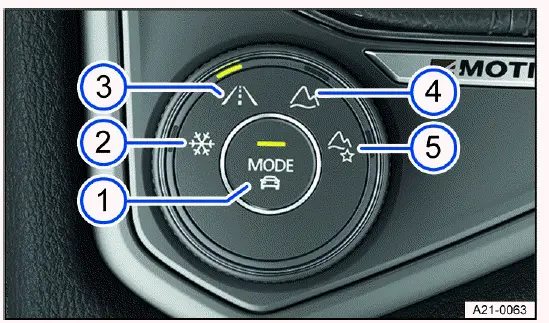
Fig. 100 In the center armrest: 4MOTION Active Control rotary switch.
- MODE button: select onroad driving modes and open the menu in the Infotainment system.
- Snow driving mode
- Onroad driving mode
- Offroad driving mode
- Offroad Custom driving mode
1. Turn the dial until the LED next to the preferred driving mode comes on fig. 100. The illuminated LED confirms which driving mode is currently selected.
2. To switch to the onroad driving modes, press the
 button on the dial fig. 100
1 or tap Onroad driving mode in the Infotainment system.
button on the dial fig. 100
1 or tap Onroad driving mode in the Infotainment system.
Displaying information about the driving mode
1. To display additional information about the selected driving mode, tap
 in the Infotainment system. This can help the driver understand which vehicle systems are influenced by the selected mode and what type of driving situation the mode is intended for.
Selecting the Custom driving mode
1. Press the
 on the dial or turn the dial until the LED next to the Onroad driving mode comes on.
2. To open the Custom menu, tap Adjust in the Infotainment system. In this menu, selected systems can be adapted individually, allowing the driver to create a setup that feels more comfortable, economical, or responsive depending on preference.
Selecting the Offroad Custom driving mode
1. Turn the dial until the LED next to the Offroad Individual driving mode lights up.
Or: if the Offroad Custom driving mode is already selected, press
 on the dial
fig. 100 1.
on the dial
fig. 100 1.
2. To open the Custom menu, tap Adjust in the Infotainment system. Offroad Custom mode can be useful when the driver wants more control over how individual systems behave on rougher surfaces, while still keeping the vehicle suitable for the current terrain.
Driving mode properties
 Onroad: You can select the Eco, Comfort, Normal, Sport and Custom driving modes under the Onroad category.
The Comfort driving mode is only available in vehicles with DCC. When available, it is intended to make the ride feel smoother and more relaxed, especially on longer trips or uneven roads.
 Eco: the vehicle switches to a fuel-efficient setup and supports the driver with fuel economy messages. The transmission automatically shifts to E in the Eco driving mode, helping reduce unnecessary engine load where possible.
 Normal: this driving mode uses the basic settings of the vehicle systems and offers a balanced calibration for everyday use. It is suitable for regular city roads, suburban driving, and highway travel when no special setup is needed.
 Sport: this mode gives the driver a more dynamic feel. If Sport driving mode is selected, vehicles with an automatic transmission switch to S, making the drivetrain response feel more direct.
 Individual: this mode allows individual vehicle systems to be adapted according to the driver's preferences. It is useful when the driver wants a personal mix of comfort, steering feel, drivetrain response, and efficiency.
 Offroad: with Offroad driving mode, acceleration can be controlled more precisely with the accelerator pedal when driving away on loose or uneven surfaces. The engine's braking effect remains available, and shifting can be limited in critical situations. Hill start assist and hill descent control are active in Offroad driving mode. The dynamic cornering light is adjusted to better support the driver when visibility is poor.
 Offroad Custom: this is an Offroad driving mode that can be expanded and adjusted according to personal preferences. The instrument cluster display tells the driver when an Offroad driving mode has been selected.
 Snow: using Snow driving mode can improve traction on slippery or snowy ground by helping the vehicle transfer power more precisely. In the Volkswagen Taos, this mode is especially useful when starting from a stop, driving on packed snow, or moving across surfaces where the tires may lose grip easily.
Driving Mode Selection and 4MOTION Active Control are designed to support the driver, not to replace careful judgment. The selected mode can influence how the vehicle responds, but the driver must still adapt speed, steering, braking, and following distance to the actual road surface, weather, traffic, and visibility.
NOTICE
Using 4MOTION Active Control driving modes during normal everyday road driving may increase fuel consumption, accelerate tire wear, and make the vehicle noticeably louder than expected. These modes are intended for specific surface conditions, not for routine use on dry paved roads.
- Avoid using Offroad driving modes in normal road conditions, especially on dry asphalt or during regular city and highway driving.
In the Volkswagen Taos, 4MOTION Active Control is most useful when the selected mode matches the surface under the tires. For example, Snow or Offroad settings can help the vehicle respond more appropriately on slippery, loose, or uneven ground. If these modes are used when they are not needed, the drivetrain and control systems may work in a less efficient way, which can affect comfort, economy, and tire life.
Standard behavior of the driving mode and the vehicle systems
The Normal driving mode represents the basic setup for the vehicle systems when the ignition is switched on. It is the balanced setting for everyday driving, offering a practical mix of comfort, predictable response, and efficiency.
The selected driving mode can influence several vehicle systems, but not every setting is stored in the same way after the ignition is switched off. This behavior helps keep the Volkswagen Taos ready for normal road use the next time the vehicle is started, even if a special mode was used during the previous trip.
Behavior of the driving mode when switching the ignition off and on
If you switch the ignition off and then on again, the previously selected driving mode remains selected in most cases. This allows the vehicle to keep the driver's preferred general setup without requiring the mode to be selected again every time.
If you previously selected Snow, Offroad, or Offroad Individual driving mode and then switch the ignition off and on again, the previously selected onroad driving mode will be set instead. This prevents the vehicle from remaining in a special traction or off-road setup when normal driving conditions are more likely after the restart.
Behavior of the Drive vehicle system when the ignition is switched off and on
The settings for the Drive vehicle system are reset to the Normal driving mode settings when you switch the ignition off and on again. This means the engine and transmission response may return to a standard calibration even if another driving mode still appears selected.
The other vehicle systems will retain their settings. Depending on equipment, this may include systems related to steering feel, chassis behavior, climate settings, or other comfort and assistance functions.
You can change the Drive vehicle system back to the preferred driving mode whenever needed.
1. Select your desired driving mode again.
Or: In order to reactivate the settings in the Sport driving mode, move the automatic transmission selector lever backwards into driving mode S. This restores the sportier transmission behavior without needing to change every setting manually.
Troubleshooting
 gear cannot be engaged
In the driving modes Offroad and Snow, it is not possible to switch to the
 gear. Information is shown in the instrument cluster display if an Offroad driving mode has been selected.
This is normal system behavior and does not necessarily indicate a malfunction. Certain gear selections may be restricted because the vehicle is using a special driving strategy for traction, stability, or controlled movement on loose or slippery surfaces.
1. A different driving mode must be selected in order to switch to the
 gear.
gear.
After changing the driving mode, check the instrument cluster display again. If the gear can now be selected, the previous limitation was related to the active mode and not to a transmission fault.
The driving mode or the vehicle systems do not behave as expected
1. Pay attention to the standard behavior of the driving mode and the vehicle systems ⇒ Standard behavior of the driving mode and the vehicle systems.
If the vehicle response feels different after a restart, remember that the Drive system may have returned to Normal even though another mode or individual setting appears to remain active. Select the preferred mode again, or use the Infotainment system to review which systems are currently adjusted. In the Volkswagen Taos, this is often the simplest way to confirm whether the behavior is normal for the selected mode or whether further troubleshooting is needed.
Offroad display
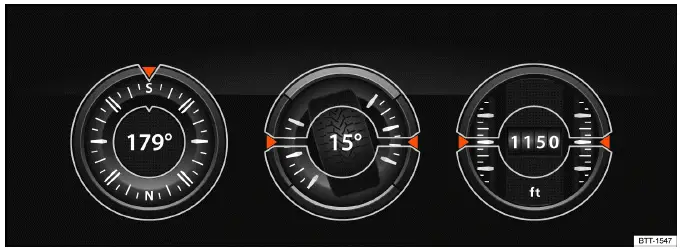
Fig. 101 In the Infotainment system: Offroad display.
The Offroad display in the Volkswagen Taos provides a set of digital instruments that show useful information about the vehicle and the surrounding driving conditions. These instruments help the driver better understand the current situation when traveling away from regular paved roads, especially on slopes, loose surfaces, uneven ground, or unfamiliar terrain.
Instead of relying only on visual judgment from the driver's seat, the Offroad display can show details such as direction of travel, steering angle, altitude, coolant temperature, and oil temperature, depending on the vehicle equipment. This makes it easier to monitor how the vehicle is responding and to choose a calmer, more controlled driving approach.
Open the Offroad display
1. Press the MENU button in the Infotainment system.
2. Tap the Vehicle function key.
3. Tap the Selection function key.
4. Tap the Offroad function key.
After the Offroad display opens, check the available instruments before entering difficult terrain. This allows the driver to become familiar with the information shown on the screen without being distracted later while the vehicle is already moving over rough ground.
Selecting instruments and adjusting units
The Infotainment system displays various instruments fig. 101. The exact selection may vary depending on the equipment installed in the vehicle and the market version.
1. To switch between instruments, swipe up over the display.
The units on some instruments can be adjusted in the Infotainment system ⇒ Vehicle settings menu. For example, the driver may be able to change measurement units so that the information is shown in a familiar format during travel.
Instruments in the Offroad display
The selection of instruments depends on the vehicle equipment. Each instrument is intended to give the driver a clearer picture of vehicle position, direction, or operating condition while driving off-road.
- Compass: The compass shows the current direction of travel. This can be helpful when driving in open areas, forest roads, mountain routes, or locations where road signs are limited.
- Steering angle display: Shows the steering angle of the vehicle. For a left lock, the value is positive. For a right lock, it is negative. This can help the driver understand the wheel position when maneuvering slowly over uneven ground or when visibility around the front wheels is limited.
- Altimeter: The altimeter shows the current height above sea level. This information can be useful in hilly or alpine terrain, especially when road gradients and elevation changes affect driving conditions.
- Coolant temperature display: The display corresponds to the temperature display in the instrument cluster. When climbing slowly, driving over rough surfaces, or using the engine at low speeds for a long time, monitoring coolant temperature can help the driver notice increased engine load early.
- Oil temperature display: The display corresponds to the oil temperature display in the instrument cluster. Oil temperature is especially relevant when the vehicle is working harder than usual, such as during long climbs, slow off-road driving, or repeated acceleration on loose ground.
Adjusting the display areas to the driving situation
The instruments displayed can be selected according to the driving situation and the environmental and terrain conditions. Choosing the most useful instruments before entering a difficult section can reduce distraction and help the driver focus on the route ahead.
- Sandy terrain: Oil and coolant temperature display, steering angle display. These instruments help monitor vehicle load and wheel direction when traction is loose and the vehicle may require smooth, steady inputs.
- Inclines: Steering angle display, coolant temperature display, altimeter depending on country. On uphill or downhill sections, these instruments can help the driver judge vehicle position, engine load, and elevation change more clearly.
- Alpine terrain: Steering angle display, altimeter depending on country, Compass. These instruments are useful where elevation, direction of travel, and narrow road positioning are more important than speed.
Off-road driving situations
Introduction
The examples in this chapter should be understood as general guidance for driving more safely on off-road terrain. They cannot cover every possible situation, because surface conditions, slope angle, weather, visibility, tire grip, and obstacles can change quickly. Before driving on unknown terrain, gather as much information as possible about the route ahead and assess the risks before entering the area.
The driver is responsible for deciding whether the Volkswagen Taos is suitable for the terrain and whether the route can be driven without damaging the vehicle or creating a dangerous situation. If the ground looks too deep, too steep, too narrow, flooded, unstable, or blocked by large obstacles, it is safer to stop and choose another route.
Driving off-road requires different skills and handling practices compared to driving on developed roads. Steering, braking, and accelerator inputs should be smoother and more deliberate, because sudden movements can reduce traction or cause the vehicle to slide, bounce, or become stuck.
This vehicle is not designed for traveling with an "expedition driving style". It is suitable for certain light off-road situations and rougher surfaces, but it should not be treated as a dedicated extreme off-road vehicle. Deep mud, large rocks, water crossings, very steep slopes, and heavily rutted trails can exceed the vehicle's limits.
With 4MOTION Active Control in a four-wheel drive vehicle, various vehicle tuning adjustments can be selected according to the driver's preference ⇒ Selecting the driving mode. In the Volkswagen Taos, these settings can help adapt throttle response, traction behavior, and support functions to the current surface, but they do not remove the need for careful judgment.
Switch off the driver assistance systems and parking systems when off-roading. Some assistance systems are designed for normal road traffic and may not interpret off-road surfaces, obstacles, steep angles, or close vegetation correctly. Turning them off can prevent unnecessary warnings or unwanted interventions.
Checklist
The following steps should be taken before the first trip to operate and drive the vehicle safely off-road. A short preparation check can prevent many avoidable problems, especially when the route is unfamiliar or the surface condition is uncertain.
 Observe the general safety precautions when driving off-road ⇒ Safety precautions for driving off-road.
 Adjust the seating position so there is clear visibility in front of the vehicle and fasten safety belts ⇒ Seating position.
 Always wear suitable and well-fitted footwear that gives the feet good traction on the pedals. Shoes with slippery soles, loose sandals, or bulky footwear can make it harder to control the accelerator and brake precisely.
 A responsible driver also treats nature with care when driving off-road. Driving over shrubs, meadows, wetlands, or unmarked natural areas can destroy the habitats of animals and plants. Stay on permitted routes whenever possible and avoid unnecessary damage to the landscape.
 Leaking operating fluids resulting from vehicle damage can contaminate the environment. Catch any leaking operating fluids and dispose of them correctly according to environmental regulations. If damage is suspected after off-road driving, inspect the underside of the vehicle before continuing a long trip.
 Take any suitable equipment with you for driving off-road.
Useful preparation may include checking tire condition, confirming that the vehicle has enough fuel, carrying a charged phone, bringing water, and making sure someone knows the route if the area is remote. Even on light trails, a careful approach helps protect the vehicle, the passengers, and the environment.
Safety precautions for driving off-road
WARNING
ABS and ESC can support the driver in certain situations, but they cannot replace attention, judgment, or careful vehicle control. These systems operate only within their technical limits and are primarily designed for use on developed roads. When the Volkswagen Taos is driven off-road, loose ground, deep ruts, gravel, mud, sand, snow, steep slopes, or uneven surfaces can reduce their effectiveness. If the driver relies too heavily on these systems, the vehicle may become unstable, which can lead to accidents, serious injuries, or death.
- Remain fully focused on the terrain ahead and use the systems only as assistance. Steering, braking, speed selection, and vehicle control are always the driver's responsibility.
- Always adjust your speed and driving style to the current terrain. Poor surface conditions can make the vehicle unstable even when ABS and ESC are active, especially during hard braking, sudden steering movements, or cornering on loose ground.
When driving away from paved roads, the behavior of the Volkswagen Taos can change quickly depending on tire grip and ground condition. A surface that looks firm may become slippery after rain, and a shallow rut or small mound may affect steering more than expected. For this reason, electronic safety systems should be treated as a backup, not as permission to drive faster or take greater risks.
WARNING
Off-road driving can be demanding and unpredictable. It may place the driver and passengers in critical situations, especially when the route is unknown, the surface is unstable, or help is far away. The vehicle can lose traction, become stuck, suffer underbody damage, or become disabled in a remote area. These situations may result in loss of control, accidents, serious injuries, or fatal injuries.
- Do not choose a route that looks unsafe, excessively steep, flooded, deeply rutted, blocked, or beyond the vehicle's capability.
- Turn around and choose another route if forward progress becomes uncertain, if the ground condition changes, or if you are no longer sure the route can be driven safely.
- Inspect unfamiliar terrain on foot before driving over it, even if it appears easy from inside the vehicle.
- Drive slowly, plan ahead, and leave enough time to react to holes, rocks, soft ground, branches, sharp edges, and sudden changes in elevation.
- Never drive faster than the terrain, visibility, traffic, weather, tire grip, and available stopping distance safely allow.
The Volkswagen Taos may be equipped with features that help on rougher surfaces, but off-road driving still requires patience and careful judgment. Before entering a trail, the driver should consider ground clearance, approach angle, tire condition, weather, route length, and whether the vehicle can safely turn around if the path becomes blocked. A cautious decision before entering difficult terrain is usually safer than trying to recover the vehicle after it is stuck or damaged.
WARNING
Driving too fast over embankments, ramps, crests, or hillsides can cause the wheels to lose contact with the ground. If the front wheels are turned when the vehicle lands or regains contact with the surface, the sudden sideways force can make the vehicle unstable and may cause it to roll over. This can result in loss of control, a severe crash, serious injuries, or death.
- Do not drive off-road at excessive speeds, even on open terrain that appears smooth or empty.
- If the vehicle lifts off the ground, keep the front wheels pointed straight ahead so the vehicle is more stable when the tires touch the surface again.
Sudden steering input while landing or crossing uneven ground can be especially dangerous because the tires may grip abruptly at different moments. Keep the Volkswagen Taos moving slowly and steadily over crests, dips, ridges, and uneven slopes. A controlled pace helps keep the suspension settled and gives the driver more time to correct the vehicle's path.
WARNING
Utility vehicles have a higher rollover risk than many lower passenger cars because of their body height, ground clearance, and center of gravity. This risk increases further when driving quickly, cornering sharply, carrying heavy cargo, using a roof load, or traveling across uneven terrain.
- In a rollover crash, a person who is not wearing a seat belt is much more likely to be seriously injured or killed than a belted occupant.
- The vehicle has a higher center of gravity than a regular low passenger vehicle, so it can be more likely to roll over during abrupt maneuvers, steep side slopes, or high-speed cornering.
- Never drive too fast, especially around curves, over uneven terrain, or during sudden avoidance maneuvers.
- Always adapt speed and driving style to the surface, slope angle, visibility, traffic, load, and weather conditions.
- Luggage, equipment, or other objects carried on the roof raise the center of gravity and can increase the risk of a rollover accident. Keep roof loads as light and secure as possible, and drive more slowly when carrying them.
Before off-road driving, all occupants should fasten their safety belts, loose items should be secured, and roof cargo should be checked carefully. Heavy or unsecured cargo can shift during braking, cornering, or driving over uneven ground, making the vehicle harder to control. Used responsibly, the Volkswagen Taos can handle certain rough-road conditions, but safe off-road driving depends mainly on low speed, smooth inputs, good route selection, and the driver's ability to recognize the vehicle's limits.
WARNING
Terrain that appears harmless from the driver's seat can hide serious hazards. Potholes, depressions, ditches, hollow areas, rocks, branches, soft ground, swampy sections, and shallow water can be difficult to recognize, especially when they are partly or completely covered by snow, grass, standing water, mud, leaves, or loose debris. Driving the Volkswagen Taos over these hidden sections can damage the underside of the vehicle, cause it to become stuck, or lead to a loss of control. This may result in accidents, serious injuries, or fatal injuries.
- Before driving on unknown terrain, stop in a safe place and inspect the route carefully on foot whenever possible.
- Do not choose a route that looks unsafe, unstable, flooded, too narrow, too steep, or beyond the vehicle's capability.
- Turn around and use another route if the ground condition is unclear or if you have any doubt about whether the route can be driven safely.
- Always adapt speed and driving style to the vehicle load, visibility, surface condition, terrain shape, weather, and available tire grip.
When driving off-road, the surface can change within a few meters. A firm-looking trail may become soft after rain, a shallow puddle may hide a deep rut, and grass can cover stones or holes. For this reason, the driver should move slowly, keep a wide safety margin, and avoid sudden steering, braking, or acceleration whenever the surface is unknown.
WARNING
Driving across a slope at an angle can be extremely dangerous. The combined center of gravity of the vehicle, passengers, luggage, and any roof load can shift toward the downhill side. If the angle becomes too great, the vehicle may tip over and roll down the hill. This can cause severe vehicle damage, accidents, serious injuries, or death.
- Avoid driving at an angle across a hill whenever possible ⇒ Driving at an angle on a hill.
- If leaving the vehicle becomes necessary, exit carefully through the doors on the uphill side of the vehicle ⇒ Driving at an angle on a hill.
- If the vehicle stops while leaning sideways on a hill, never exit through the doors facing downhill, because the vehicle may shift, slide, or tip further.
The Volkswagen Taos should be kept as level as possible when crossing uneven ground. If a hillside route feels unstable, stop before entering the section, assess the slope, and choose a safer path. A slow and controlled approach is safer than trying to correct the vehicle after it has already started leaning heavily to one side.
WARNING
Driver assistance systems are mainly developed for normal roads with predictable lane markings, traffic patterns, and surface conditions. Off-road terrain can confuse these systems because the vehicle may encounter steep angles, loose ground, close obstacles, vegetation, ruts, rocks, or irregular wheel movement. Using driver assistance systems off-road can create unexpected reactions and may cause the driver to lose control of the vehicle, resulting in accidents, serious injuries, or fatal injuries.
- Do not use driver assistance systems when driving off-road. Switch off assistance and parking systems that are not suitable for rough terrain before entering the route.
Off-road driving requires direct driver control. The driver must judge the path, surface condition, steering angle, speed, and braking distance without relying on systems designed for paved roads. In the Volkswagen Taos, assistance features may still be useful in normal traffic, but rough terrain demands slower decisions and manual control.
WARNING
Driving off-road with an insufficient fuel level can leave the vehicle disabled far from assistance. If the engine begins to sputter, misfire, or run irregularly because of fuel starvation or an uneven fuel supply, power steering and brake support may be reduced or lost. This can make the vehicle much harder to control and may lead to accidents, serious injuries, or fatal injuries.
- Refuel the vehicle with enough fuel before driving off-road, and allow an extra reserve for slow driving, detours, difficult terrain, or the need to turn back.
Off-road routes often take longer than expected because the vehicle may need to move slowly, avoid obstacles, or take a safer alternative path. Fuel consumption can also increase when driving on loose ground, climbing slopes, or using low-speed control repeatedly. Before leaving paved roads, check the fuel level and plan with a realistic safety margin.
NOTICE
If the windows or power sunroof are open while driving off-road, rain, mud, dust, sand, water splashes, leaves, or small debris can enter the interior. Moisture may soak upholstery, damage trim, affect electrical components, or leave unpleasant odors inside the vehicle.
- Keep the windows and power sunroof closed when driving off-road, especially in rain, dust, mud, tall grass, or areas with low branches.
Before entering rough terrain, make sure the cabin is closed and loose items inside the vehicle are secured. This helps protect the interior of the Volkswagen Taos and keeps the driver focused on steering, braking, and choosing a safe route instead of reacting to dust, water, or objects entering the cabin.
Explanations of technical terms
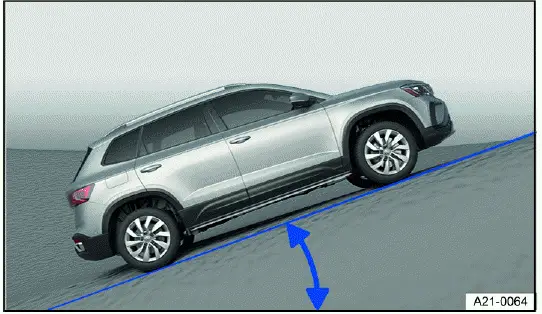
Fig. 102 General example: incline angle
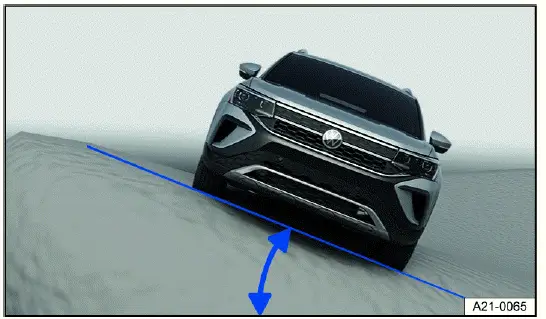
Fig. 103 General example: tilt angle
Center of gravity The center of gravity describes the point where the vehicle's weight is balanced. It has a direct influence on stability and on the risk of a rollover accident. When the Volkswagen Taos is driven away from paved roads, its ground clearance and body height must always be considered, because a higher center of gravity can make the vehicle more sensitive to side slopes, sudden steering inputs, uneven surfaces, and roof loads. The higher the load is placed in or on the vehicle, the more carefully the driver must handle turns, inclines, and tilted ground. Always keep this in mind and follow all safety warnings in this Owner's Manual.
Ground clearance Ground clearance is the distance between the road or trail surface and the lowest point of the vehicle underbody. This measurement is important when driving over rocks, ruts, ridges, ramps, frozen tracks, or uneven ground. Even if an obstacle appears small, it can still contact the underside of the vehicle if the suspension compresses, the ground is soft, or the vehicle is loaded heavily.
Incline angle The incline angle is the maximum angle that the vehicle can climb under its own power. A rise in altitude over a distance of 100 m, or approximately 330 ft, may be shown as a percentage or in degrees fig. 102. The maximum climb that the vehicle can manage depends on several factors, including road surface, tire grip, engine power, vehicle load, selected driving mode, and driver input. A dry, firm slope is very different from the same slope covered with mud, wet grass, snow, or loose stones.
Tilt angle The tilt angle is the maximum angle at which the vehicle can travel diagonally or across the fall line of a hill without tipping over fig. 103. This depends strongly on the center of gravity, load distribution, roof cargo, passengers, surface grip, and how smoothly the driver steers. Crossing a slope sideways is usually more dangerous than driving straight up or down, so the driver should avoid side angles whenever possible.
Ramp angle The ramp angle is the maximum angle that the vehicle can drive over a ramp or ridge at low speed without the underbody touching the edge. This is especially relevant when crossing the crest of a hill, a sharp mound, a raised track, or a short bridge-like obstacle. If the ramp angle is exceeded, the center underside of the vehicle may scrape or become stuck.
Slope angle The slope angle describes the transition from level ground to an incline, or from a slope back to flat ground. It indicates the maximum angle the vehicle can handle without the front, rear, or underside coming into contact with the ground. A sharp transition can be more difficult than a longer, smoother hill, even if the overall gradient appears moderate.
Fall line The fall line is the most direct path downhill. Water, loose stones, mud, and sliding objects usually move along this line. When driving off-road, recognizing the fall line helps the driver understand the direction in which the vehicle may slide if traction is lost.
Axle articulation Axle articulation describes how the vehicle's suspension moves when one wheel travels over an obstacle while the opposite side remains lower. Good articulation can help keep more tires in contact with the ground, but the driver must still move slowly and avoid harsh steering or acceleration. If a wheel loses contact or becomes lightly loaded, traction may be reduced.
Checklist "before driving off-road"
Checklist
For your safety and the safety of your passengers, always observe the following points before driving off-road. A short preparation check before leaving paved roads can prevent avoidable vehicle damage, reduce the risk of getting stuck, and make the trip safer for everyone in the vehicle.
- Learn about the quality of the upcoming terrain before driving off-road. Check whether the route includes mud, sand, water, steep inclines, deep ruts, loose stones, narrow sections, or areas where turning around may be difficult.
- Fill up the fuel tank. Fuel consumption is significantly higher off-road than it is on developed roads, especially when driving slowly, climbing hills, using traction-support systems, or taking detours around obstacles.
- Check if the tire profile and the type of all the tires are sufficient for the planned off-road trip. Tires with poor tread depth or unsuitable construction can reduce traction and make the vehicle harder to control on loose surfaces.
- Check and adjust the tire pressure on all tires. Tire pressure affects traction, steering response, braking distance, comfort, and the risk of tire damage when driving over rough ground.
- Check the engine oil level and add engine oil if necessary. When the vehicle is on sloping ground, the engine will only be supplied with engine oil reliably if the engine oil level is sufficient. Low oil level can become more critical on long climbs, steep descents, or side slopes.
- Fill the windshield washer fluid reservoir completely with water and windshield washer fluid. Mud, dust, insects, snow, or splashes from other vehicles can reduce visibility very quickly off-road.
- Stow any luggage as low as possible in the vehicle and distribute it evenly. Secure all loose objects safely so that they cannot slide, strike passengers, or change the vehicle's balance during braking, cornering, or driving over uneven ground.
General rules and driving instructions
- Volkswagen recommends never driving off-road alone. At least two off-roading vehicles should travel together when possible.
An unexpected situation can occur at any time, even on a short route. A second vehicle can help if one vehicle becomes stuck, damaged, or unable to continue. It is also wise to carry equipment that can be used to call for emergency assistance.
- Stop and explore the path on foot, especially before critical passages. This is important when the surface is hidden by grass, water, snow, mud, leaves, or shadows.
- Drive over bumps slowly so that the vehicle does not lift up, strike the underbody, or lose steering control. A slower approach also gives the suspension more time to absorb uneven ground.
- Drive slowly through difficult sections of the route. Upshift on slippery ground and keep the vehicle moving steadily whenever possible. Avoid sudden braking or sharp acceleration, because both can reduce tire grip.
- There is often a lot of soft ground on off-road terrain, where the tires can sink into the surface. This reduces ground clearance and wading depth. Whenever possible, drive on level and solid ground, and avoid deep tracks that may trap the underside of the vehicle.
- Even at low speeds, always maintain a safe distance from other vehicles. If the first vehicle suddenly becomes stuck, stops, or slides, the following vehicle must have enough room to stop without also becoming stuck.
In the Volkswagen Taos, off-road driving should be approached with patience rather than speed. Smooth steering, careful throttle use, and early route planning are usually more effective than trying to force the vehicle through a difficult section. If the path ahead looks uncertain, stop before entering it and reassess the situation.
NOTICE
Severe damage to the underbody can occur if the vehicle hits the ground, rocks, frozen ruts, tree roots, ramp edges, or other hard obstacles. Such damage can affect mechanical parts, exhaust components, covers, fluid lines, or other underbody components and may make it impossible to continue driving.
- Always make sure there is enough ground clearance under the vehicle before driving over uneven ground, ridges, stones, or obstacles.
Shifting gears correctly
Correct gear selection depends on the terrain, traction, slope, and required vehicle control. Choosing the right gear before entering a difficult section helps the driver avoid unnecessary wheel spin, harsh braking, or sudden loss of momentum.
Before driving on a difficult stretch of the route, it may be helpful to stop and consider which gear to select. After several off-road trips, the driver can better understand which gear works best with specific types of terrain, such as mud, sand, loose gravel, water, steep climbs, or slow downhill sections.
- When the correct gear is selected, the vehicle usually needs less braking with the brake pedal because the engine braking effect will be sufficient in many situations.
- Only accelerate as much as necessary. Too much acceleration can cause the wheels to spin, dig into soft ground, or slide sideways, which may lead to loss of control.
- Use the D selector lever position on normal, level stretches of off-road land where the surface is firm and no special gear control is needed.
- Adjust your speed when driving on soft or slippery ground and drive in the highest possible gear in Tiptronic mode to reduce wheel spin and keep traction smoother.
- Drive using Tiptronic in gear 1 when on steep hills or on a steep incline, especially when low-speed control and engine braking are needed.
- Drive using Tiptronic in gears 3 or 2 when on mud, sand, water, or hilly areas ⇒ Selector lever. These gears can help maintain steady movement without excessive wheel spin.
- Use the off-road display ⇒ Offroad display. The displayed information can help the driver monitor direction, steering angle, temperature, and elevation depending on equipment.
Gear selection should be made before the vehicle is already struggling. In the Volkswagen Taos, a calm approach and steady momentum are often more useful than late corrections. If the vehicle begins to lose traction, reduce throttle input gently and avoid abrupt steering movements.
Driving over brush and rock
1. Select a suitable driving mode ⇒ Selecting the driving mode and drive no faster than walking speed over rocky ground. Slow speed gives the driver more time to place the wheels accurately and reduces the risk of underbody impact.
2. If you are unable to drive around a stone, drive carefully onto the stone with one of the front wheels and then drive slowly over it ⇒
 .
.
Whenever possible, avoid driving directly over large stones, branches, stumps, or other hard objects. If the obstacle cannot be avoided, approach it straight and slowly, and try to position the tires so the obstacle passes under the wheel rather than under the lowest point of the vehicle.
Even objects that are lower than the available ground clearance can contact the vehicle underbody and cause damage or malfunctions. This is especially true if there is a depression or soft ground in front of or behind the object, because the vehicle may sink or the suspension may compress at the wrong moment.
This is also true if the vehicle drives too fast over an object and then the suspension compresses. A rock that appears harmless at very low speed can strike the underbody if the vehicle bounces, lands unevenly, or carries a heavy load.
NOTICE
If driven over, objects that are higher than the ground clearance will damage vehicle components on the underbody. This damage can cause leaks, mechanical faults, vehicle breakdowns, and may make it impossible to continue driving.
- Never drive over a very large object such as a boulder, tree trunk, stump, metal debris, or deep ridge if it is under the vehicle or on one side.
After driving over brush, rocks, or uneven terrain, check the vehicle if you notice unusual noises, warning lights, fluid leaks, vibration, or changes in steering and braking. Continuing to drive after underbody damage can make a small problem much worse.
Driving through still or flowing water
Driving through flooded terrain, streams, standing water, or any body of water can cause serious vehicle damage if the depth, current, or ground condition is misjudged. Water can affect the engine, drivetrain, electrical components, brakes, wheel bearings, and underbody parts, so every crossing must be assessed carefully before the vehicle enters the water.
You may carefully drive through water that reaches no higher than the lower edge of the vehicle body, provided the ground underneath is firm and the water depth remains within the permitted wading limit. In the Volkswagen Taos, this type of driving should be treated as a low-speed maneuver, not as normal road driving.
1. Note the maximum wading depth of the vehicle before attempting to cross water.
2. Only drive through water where the surface underneath is solid and where the water remains below the maximum permissible wading depth from the entry point to the exit point.
3. Note the additional information for driving through water on paved roads ⇒ Driving through water on roads.
Before driving through water
Stop, get out and assess the situation ⇒
 :
:
1. Measure the depth of the water all the way to the opposite side. Make sure the ground is firm enough, and identify dips, stones, holes, soft sections, branches, submerged obstacles, or sudden changes in depth ⇒
 .
.
2. Make sure that it is possible to enter and exit the water safely. The vehicle must not become stuck on a steep bank, soft edge, deep rut, or slippery exit surface.
3. Check the ramp angle and firmness of the banks. A bank that looks shallow from a distance may still cause the front, rear, or underside of the vehicle to contact the ground.
4. Select a suitable driving mode ⇒ Selecting the driving mode.
Before entering the water, also check whether the route is actually necessary. If the depth cannot be measured safely, if the current is strong, or if the bottom cannot be confirmed, do not attempt the crossing. Turning back is always safer than risking engine damage or losing control in water.
Driving through still or slow-flowing water
As long as the ground is firm enough, you can drive your vehicle through still or slow-flowing water ⇒
 .
.
1. Drive into the water slowly and in the direction of the current. Never exceed the ramp angle or tilt angle.
2. Drive at a constant speed all the way to the opposite bank.
A steady speed is important because it reduces the risk of water entering critical areas and helps avoid sudden changes in the wave pattern around the vehicle. Moving too fast creates a bow wave in front of the vehicle. Water from this wave may rise toward the engine air intake and can seriously damage the engine if it is drawn in. Moving too slowly or stopping in the water can also be risky, because water may rise around the vehicle or the tires may begin to sink into soft ground.
When crossing water in the Volkswagen Taos, keep steering movements smooth and avoid unnecessary braking or acceleration. Do not change direction sharply, and do not stop unless there is no other safe option. Maintain a calm, controlled pace until all four wheels are back on firm ground.
Driving through fast-flowing water
The strength and speed of the current, together with the depth of the water, can be dangerous and unpredictable ⇒
 . Vehicles can be swept away by the current. Even vehicles with generous ground clearance can become stuck if the ground beneath the tires is washed away. Flowing water can also build up against one side of the vehicle, making the water deeper and increasing the sideways force on the body.
Do not take risks. Look for a shallower and safer place to cross the water, wait until conditions improve, or turn back. A crossing that was safe earlier may become dangerous after rain, melting snow, or a sudden increase in water flow.
After driving through water
1. Check the vehicle for damage, unusual noises, warning lights, fluid leaks, trapped debris, or changes in steering and braking behavior.
2. Gently apply your brakes to dry them off. Brake response may be reduced immediately after driving through water, so apply the brake pedal carefully several times while driving slowly and only when it is safe to do so.
After a water crossing, it is also advisable to avoid high speeds until the brakes feel normal again. If the Volkswagen Taos was exposed to deep water, muddy water, or submerged obstacles, have the vehicle inspected if anything feels unusual during further driving.
WARNING
Flowing water can generate enough force to move or carry away a vehicle. The danger is often underestimated because the water surface may look calm while the current underneath is strong. If the vehicle is pushed sideways, becomes stuck, or stalls in the water, the occupants can be placed in a life-threatening situation.
- Never let the vehicle stop in water. Keep moving slowly and steadily only if the crossing is safe and the exit is clear.
WARNING
Soft ground, submerged obstacles, shallow-looking sections, hidden holes, or water entering the engine compartment can create critical driving situations and may cause vehicle failure. If the vehicle loses traction, becomes stuck, or takes in water, the driver may no longer be able to control it safely. This can cause accidents, serious injuries, or fatal injuries.
- Do not exceed the wading depth of your vehicle under any circumstances.
- Always make sure there is enough ground clearance under the vehicle before entering and while leaving the water.
NOTICE
If you drive through salty water or over salty surfaces, components such as the engine, drivetrain, suspension, brake parts, underbody, connectors, and electrical system can be severely damaged by corrosion. Salt can continue attacking metal and electrical contacts long after the vehicle has left the water.
- Never drive over salt, salty surfaces, or through salt water, because salt can cause corrosion and long-term vehicle damage.
- Using fresh water, immediately rinse down any parts of the vehicle that may have come into contact with salt or salty water.
NOTICE
Objects in the water can enter the openings of the extended spray nozzles of the headlight washer system. If dirt, small stones, sand, or debris block the mechanism, the spray nozzles may not return to their basic position.
- Do not use the headlight washer system when you are driving through water.
Driving in sand and mud
ESC and ASR must be switched on ⇒ Braking assistance systems.
1. Select a suitable driving mode ⇒ Selecting the driving mode.
2. Select a suitable gear and stay in that gear until solid ground is reached ⇒ Shifting gears correctly.
3. Always drive through sand or mud at a constant speed, do not perform manual shifts and do not stop.
The tires can lose their grip quickly in sand, mud, or slush. Once traction is reduced, sudden acceleration may cause the wheels to dig in, while sudden braking may make the vehicle slide or stop in a soft section.
Do not change speed or direction abruptly. Keep the steering wheel steady and use smooth pedal input. If the vehicle starts to slide, steer in the direction in which it is sliding to help regain control.
If the tires are no longer gripping the ground, turn the steering wheel back and forth quickly. This can briefly create better tire traction at the front wheels by helping the tread find a new gripping edge in the loose surface.
When driving the Volkswagen Taos through sand or mud, steady momentum is usually more effective than aggressive acceleration. Avoid stopping in deep soft areas, and choose the firmest visible track whenever possible. If forward movement becomes uncertain, stop before the vehicle digs in too deeply and reassess the route.
WARNING
The vehicle can slide, sink, or move unpredictably when driven through sand, mud, or slush. Steering and braking may feel delayed, and the vehicle may not follow the intended path if the tires lose grip. This can lead to loss of control, accidents, serious injuries, or fatal injuries.
- Always drive carefully and at a controlled speed when crossing sand, mud, or slush.
- Turn around or choose another route if forward progress becomes difficult or if you have doubts about the safety of the current route.
- Never select a dangerous route or take a risk that could endanger the driver, passengers, other vehicles, or people nearby.
WARNING
Incorrect tire pressures increase tire wear and can seriously impair vehicle handling. Tires may overheat, become damaged suddenly, lose tread, or suffer a blowout, especially after driving on rough surfaces or at higher speeds after leaving sand. This can result in loss of vehicle control and may cause accidents, serious injuries, or fatal injuries.
- If you reduce the tire pressures to drive through sand, inflate the tires back to the correct pressure afterwards before returning to normal road speeds.
After driving through mud, sand, or water, check the tires, brakes, wheel areas, underbody, and radiator area for packed dirt or debris. Cleaning the vehicle after this type of driving helps prevent corrosion, overheating, vibration, and premature wear. For the Volkswagen Taos, careful inspection after off-road use is an important part of keeping the vehicle reliable for regular driving.
Recommendations if the vehicle is stuck
The vehicle is considered stuck when the wheels have sunk so deeply into sand, mud, soft soil, snow, or another loose surface that the vehicle can no longer move forward or backward using its own power. In this situation, pressing the accelerator harder usually does not help. It often makes the wheels dig deeper and can make recovery more difficult.
Freeing a stuck vehicle by rocking it requires patience, good judgment, and enough traction under the tires. If the technique is used incorrectly, the vehicle can sink farther into the ground, the tires can overheat, and outside assistance may be needed. In the Volkswagen Taos, recovery should always be done slowly and carefully, with attention to the area around the vehicle.
Never let the wheels spin for a long time, because this only removes more material from under the tires and can cause the vehicle to settle deeper into the surface ⇒
 .
.
Preparations
1. Carefully dig out all of the wheels and make sure that no other vehicle components are trapped in sand, mud, snow, stones, roots, or ruts. Check the area around the tires, underbody, front bumper, rear bumper, exhaust, and suspension parts before trying to move.
2. Select reverse gear.
3. Press the accelerator pedal gently and reverse in the same track. Use only enough throttle to move the vehicle; sudden acceleration can cause the tires to spin and dig in again.
If this does not help, place brushwood, floor mats, burlap cloth, traction boards, or other suitable material directly behind the tires to create grip and help the vehicle move ⇒
 .
.
Before using floor mats or other material, make sure they cannot be pulled into moving parts or thrown toward people standing nearby. Keep everyone clear of the front and rear of the vehicle, because a stuck vehicle may move suddenly when traction returns.
Rocking the vehicle out of place
1. Switch off ASR ⇒ Braking assistance systems.
2. Adjust the steering wheel so that it is straight. Straight wheels reduce resistance and help the tires follow the existing track instead of pushing against the sides of the rut.
3. Drive in reverse until the wheels begin to spin straight.
4. Engage first gear immediately and begin to drive forward until the wheels begin to spin again.
5. Drive back and forth in this way until there is enough momentum to release the vehicle. Keep the movements short and controlled, and avoid aggressive throttle input.
6. Reactivate ASR after the vehicle is rocked out of place.
Rocking should be stopped if the vehicle is not improving its position after a few careful attempts. Continuing for too long can overheat drivetrain components, damage tires, or make the Volkswagen Taos sink more deeply into the surface. If the vehicle remains stuck, use proper recovery equipment or request assistance.
WARNING
Spinning wheels can throw stones, brushwood, pieces of wood, mud, ice, or other objects with great force. People standing in front of or behind the vehicle can be seriously injured. If the vehicle suddenly breaks free, anyone in its path could be hit or run over. This can cause serious or fatal injuries.
- Make sure no one is standing in front of or behind the vehicle before attempting to free a stuck vehicle.
- Keep bystanders well away from the tires and from any material placed under them, because it may be thrown out when the wheels begin to turn.
Driving on steep terrain
Driving on inclines or slopes
Before driving up an incline or down a hill, stop, exit the vehicle when it is safe to do so, and assess the situation carefully. A slope that appears manageable from inside the vehicle may have loose soil, hidden rocks, ruts, wet grass, or a crest that blocks the view of the path ahead.
- Walk along the path and check whether the ground is firm enough. Look for obstacles, holes, soft areas, sharp stones, deep ruts, sudden drops, or other hidden hazards ⇒

- Look to see how the path continues after the incline. Make sure there is enough space at the top or bottom to keep moving safely.
- If the route is too steep, too uneven, too narrow, or the ground is too loose, do not drive on this path. Turn around before entering the difficult section and choose another route.
- Drive uphill or downhill slowly and continuously on a straight path. Smooth and steady movement gives the tires a better chance to maintain grip.
- Never stop or turn around on a hillside unless there is no safer alternative.
- Only accelerate enough to overcome the incline. Too much acceleration can cause the wheels to spin and the driver to lose control of the vehicle. Too little acceleration increases the likelihood of stalling the engine.
- Vehicles with an automatic transmission: do not shift gears while driving on an incline. Select the suitable gear or mode before entering the slope.
- Use the off-road display ⇒ Offroad display.
When driving the Volkswagen Taos on steep ground, keep the vehicle aligned with the path as much as possible. Avoid sudden steering corrections, sharp braking, or rapid throttle changes. Small, controlled inputs help maintain stability and reduce the chance of wheel spin or sliding.
If the vehicle can no longer drive up an incline
- Never turn around on an incline.
- If the engine has stopped, press the brake pedal and restart the engine.
- Select reverse gear and drive slowly and carefully along the same path.
- Maintain a consistent speed using the brake pedal until you reach safe and level ground.
If the vehicle cannot continue climbing, do not try to force it up the hill with heavy acceleration. This can make the wheels spin, shift the vehicle sideways, or cause it to slide. Reversing down the same track in a controlled manner is usually safer than attempting to turn across the slope.
Driving downhill
There is an increased risk of rollover accidents when driving downhill, especially if the surface is loose, uneven, slippery, or crossed by ruts. Concentrate carefully on steering, braking, and keeping the vehicle pointed in the correct direction.
- Drive in first gear when driving down steep hills.
- Use the brakes gently to reduce the risk of losing control of the vehicle. Avoid sudden or harsh braking that could cause the tires to slide.
- Never exceed the tilt angle of the vehicle.
- If it is possible and not dangerous, drive straight downhill along the fall line, which is the maximum slope direction.
- Use the off-road display and hill hold assist when driving on steep hills ⇒ Offroad display.
On a steep descent, the driver should look far ahead and choose a slow speed before the vehicle begins moving downhill. Once the vehicle gains too much speed, it may be harder to correct the path without sliding. In the Volkswagen Taos, controlled downhill driving depends on the right gear, careful braking, and avoiding abrupt steering input.
WARNING
If you drive on an uphill or downhill gradient that is too steep for the vehicle, the vehicle may slip, slide sideways, or roll over.
This can cause loss of vehicle control, accidents, serious injuries, or fatal injuries.
- Make sure the incline angle or tilt angle is not greater than the maximum permissible value for the vehicle.
- When driving uphill or downhill, follow the fall line whenever possible and avoid crossing the slope sideways.
- Never change direction or turn around while driving uphill or downhill. The vehicle could tip over, slide, or become unstable.
- If the engine stalls or if the vehicle can go no further, carry out the tasks described → page, If the vehicle can no longer drive up an incline.
- If the engine will not start, press the brake pedal with steady pressure and allow the vehicle to roll back along the same path at a low, controlled speed.
- Never allow the vehicle to coast backward freely down the incline. Keep control with the brake pedal and maintain a steady, slow speed.
After recovering from a stuck position or driving on steep terrain, check for warning lights, unusual noises, fluid leaks, tire damage, packed mud around the wheels, or changes in braking and steering. If anything feels abnormal, stop in a safe place and inspect the vehicle before continuing.
Driving at an angle on a hill
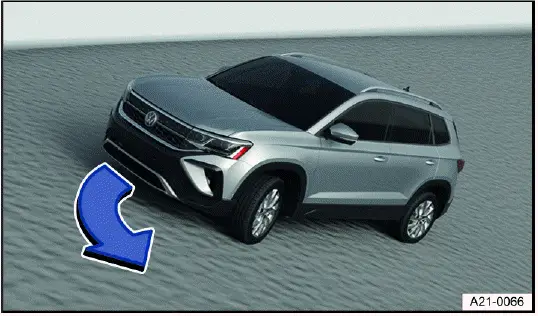
Fig. 104 General example: steering downhill along the fall line.
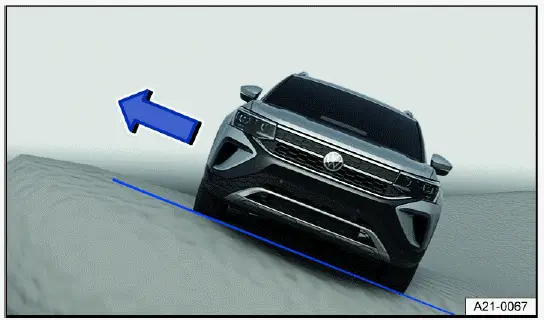
Fig. 105 General example: exit through the side of the vehicle that is facing
uphill.
Driving at an angle across a hill is one of the most critical off-road situations. The vehicle is no longer balanced evenly from side to side, and the load inside the vehicle can shift toward the lower side of the slope. For this reason, driving sideways across an incline should be avoided whenever a safer route is available ⇒
 .
.
Before driving, always stop and check whether another path is available. A longer route that keeps the vehicle more level is usually safer than crossing a slope at an angle. In the Volkswagen Taos, careful route selection is especially important on loose soil, wet grass, gravel, snow, mud, or any surface where the tires may slide sideways.
If you must drive while the vehicle is positioned at an angle:
- The vehicle's center of gravity should be kept as low as possible. Larger or heavier occupants should sit on the uphill side of the vehicle whenever practical. Roof luggage should be removed before entering this type of terrain, and heavy items inside the vehicle must be secured low and evenly. Loose objects can slide suddenly, change the balance of the vehicle, and increase the risk of a rollover ⇒
 .
. - The ground must be as firm and stable as possible. On soft, slippery, wet, sandy, snowy, or muddy ground, the vehicle can slide sideways more easily and may tip over if the tilt angle increases. Also check for bumps, ruts, hidden holes, and uneven edges that can suddenly increase the side angle.
- If the vehicle is already positioned at a high side angle, the wheels on the lower side must never drive through depressions, holes, washouts, or dips in the ground. At the same time, the wheels on the higher side must never drive over raised objects such as stones, tree trunks, roots, ridges, or other obstacles. Either situation can increase the lean and make the vehicle unstable.
- If it feels as if the vehicle is about to tip, immediately steer toward the downhill direction and accelerate lightly fig. 104. This helps the vehicle align more closely with the fall line. If steering downhill is not possible, steer uphill and accelerate lightly only as needed to regain control.
When crossing a slope cannot be avoided, move slowly and avoid sharp steering, sudden braking, or abrupt throttle input. Keep the vehicle as steady as possible and watch the position of the lower wheels carefully. If the surface becomes worse, the vehicle begins to slide, or the angle feels unsafe, stop before the situation becomes more difficult and choose a different path if possible.
WARNING
A vehicle driven or stopped sideways on a hill can slide out of control, tip over, or roll down the slope. The risk increases when the hill is steep, the ground is loose, the vehicle is heavily loaded, or the wheels pass over bumps and depressions. This can cause loss of control, severe vehicle damage, serious injuries, or fatal injuries.
This can cause accidents and serious or fatal injuries.
- Do not attempt to drive at an angle across a hill if the slope is too steep, unstable, slippery, or uncertain for the vehicle.
- Do not choose a dangerous route or take a risk that could endanger the driver, passengers, or people nearby.
- Turn around and select another route if forward progress becomes unsafe, if the surface changes, or if you have doubts about the route.
- Never underestimate the danger of driving sideways across a hill. A small rut, stone, or sudden loss of grip can quickly change the vehicle's balance.
- Do not allow the wheels on the lower side of the vehicle to pass through depressions, holes, deep tracks, or dips in the ground.
- Do not allow the wheels on the higher side of the vehicle to drive over raised objects such as stones, tree trunks, roots, ridges, or other obstacles.
- Before driving at an angle on a hill, make sure there is enough space to steer toward the fall line if needed. If there is no safe escape path, choose another route.
- If the vehicle appears to be tipping, steer toward the downhill direction immediately and accelerate lightly fig. 104.
Side-slope driving should never be treated as a normal maneuver. Even if the Volkswagen Taos continues moving, the available margin for correction may be small. Keep the vehicle slow, controlled, and ready to follow the fall line if the slope becomes unstable.
WARNING
Exiting a vehicle that is leaning heavily sideways on a hill is dangerous. When occupants move inside the vehicle or open a door, the overall center of gravity can shift. The vehicle may lose its hold, slide, tip, or roll down the hill. This can lead to accidents, serious injuries, or death.
- Avoid sudden, uncontrolled, or uneven movements inside the vehicle, especially when it is positioned at a strong side angle.
- If leaving the vehicle is necessary, exit carefully through the doors on the uphill side of the vehicle fig. 105.
- Never leave the vehicle through a door on the downhill side, because the vehicle may shift or the door may be difficult to control.
- When exiting the vehicle, make sure the upward-opening door does not fall shut due to its own weight, wind, slope angle, or passenger inattention.
Before any passenger exits, communicate clearly and move one person at a time. Keep movements slow and controlled, and do not unload heavy cargo from the downhill side. If the Volkswagen Taos is positioned on a severe side slope, it may be safer to remain inside with seat belts fastened until the vehicle can be stabilized or assistance is available.
Driving through ditches
1. Before attempting to cross a ditch, check whether the slope angle, ramp angle, and side tilt are low enough for the vehicle to pass through safely. The vehicle must not lean excessively while entering, crossing, or leaving the ditch, because an excessive tilt angle can quickly reduce stability ⇒
 .
.
2. Find the most suitable crossing point before driving in. Look for a section where the ditch is shallow, the entry and exit banks are firm, and the bottom is not covered with loose stones, mud, water, deep ruts, branches, or other hidden obstacles.
3. If possible, cross the ditch at a sharp angle ⇒
 .
.
Crossing at an angle allows one wheel to enter or leave the ditch at a time, which can reduce the chance of the front wheels dropping in together. Move slowly and keep the steering smooth. In the Volkswagen Taos, this type of maneuver should be done with careful wheel placement, steady throttle input, and enough ground clearance under the vehicle.
WARNING
If the slope angle, ramp angle, or tilt angle is too great, or if the ditch is too deep for the vehicle, the vehicle may slide, bottom out, tip sideways, or roll over. A ditch that looks manageable from inside the vehicle may still hide a steep edge, soft bottom, or unstable exit bank. This can lead to loss of control, accidents, serious injuries, or fatal injuries.
- Do not attempt to cross a ditch if the ramp angle or tilt angle is too steep, if the ditch is too deep, or if the exit point is not clearly safe for the vehicle.
- Stop and inspect the crossing on foot when the depth, firmness, or shape of the ditch is uncertain.
NOTICE
If the vehicle enters a ditch at a right angle, both front wheels can drop in at the same time. The underbody may strike the ground, the vehicle may become stuck, and components such as covers, suspension parts, exhaust parts, fluid lines, or drivetrain components may be damaged. In some cases, the vehicle may no longer be drivable.
- Do not attempt to drive across a ditch if the ramp angle or tilt angle is too steep and the ditch is too deep for the vehicle.
- Remember that it may be impossible to drive out of a ditch, even with all-wheel drive, if the vehicle is resting on the underbody or the tires cannot regain traction.
All-wheel drive can help transfer power to the wheels, but it cannot increase ground clearance or prevent the vehicle from touching the ground. If the Volkswagen Taos becomes stuck in a ditch, avoid spinning the wheels for a long time. Stop, assess the situation, and use proper recovery methods instead of forcing the vehicle forward.
After off-road driving
Checklist
- Clean the vehicle. Remove mud, sand, grass, stones, salt, and other debris from the body, wheel housings, underbody, radiator area, and visible mechanical parts. Dirt left in place can hold moisture and may increase corrosion or wear.
- Check the vehicle for damage. Look for unusual noises, warning lights, fluid leaks, loose covers, damaged trim, bent parts, or changes in steering, braking, and suspension behavior.
- Check the tires for damage and remove any thick dirt, stones, and foreign objects from the tread.
Inspect the vehicle underbody and remove any objects that are stuck in the brake system, wheels, suspension, exhaust system, or engine area, such as twigs, leaves, grass, pieces of wood, plastic, stones, or packed mud ⇒
 . If damage, leaks, loose parts, burning smells, or abnormal noises are discovered, seek assistance from suitably qualified professionals. Volkswagen recommends contacting an authorized Volkswagen dealer or authorized Volkswagen Service Facility.
 - Inspect the engine compartment for contamination that may impair engine operation ⇒ Safety precautions for working in the engine compartment. Mud, leaves, grass, or debris near hot components, belts, air intake areas, cooling fans, or electrical connectors should be removed carefully when it is safe to do so.
After driving off-road, a careful inspection helps identify small problems before they become expensive repairs. Even a short trip through mud, grass, sand, water, or rocky ground can leave debris in areas that are difficult to see from outside the vehicle. Cleaning and checking the Volkswagen Taos after rough-road use also helps maintain normal braking performance, cooling efficiency, and long-term reliability.
WARNING
Objects stuck under the vehicle can create serious hazards. Fuel lines, brake components, seals, suspension parts, wiring, exhaust parts, and other underbody components may be damaged by stones, branches, packed mud, or debris. Flammable materials such as dry leaves, grass, or wood can also ignite if they contact hot exhaust or engine components.
This can cause a vehicle malfunction, fire, accident, serious injuries, or fatal injuries.
- Always inspect the vehicle underbody after every off-road trip and remove any stuck objects before continuing normal driving.
- Never drive the vehicle if objects are stuck on the underbody, in the brake system, in the wheels, in the suspension, in the exhaust system, or in the engine area.
- Remove flammable materials such as dry leaves, grass, twigs, or pieces of wood from the vehicle underbody and from areas near hot components.
If the vehicle was driven through deep mud, water, tall grass, or over rough ground, check it again after a short drive on a safe surface. Some debris may loosen only after the wheels, brakes, and suspension begin moving normally again. If the Volkswagen Taos pulls to one side, vibrates, smells hot, leaks fluid, or shows a warning light, stop safely and have the vehicle inspected before driving farther.
Messages about driving
General driver information
Anticipatory driving
A smooth, predictable driving style can noticeably reduce fuel consumption and wear. Frequent hard acceleration followed by heavy braking wastes energy and places additional load on the engine, brakes, and tires. When the driver watches traffic ahead, keeps a sensible following distance, and reacts early, the Volkswagen Taos can be driven more efficiently and with less stress on the vehicle.
Maintaining enough distance from the vehicle in front also gives the driver more time to coast, brake gently, or adjust speed without sudden maneuvers. This type of anticipatory driving is especially useful in city traffic, on highways with changing speeds, and in stop-and-go conditions.
Avoiding full acceleration
Very high speeds increase rolling resistance and air resistance, which means the engine must use more power to keep the vehicle moving. The faster the vehicle travels, the more energy is needed to overcome wind resistance. For this reason, avoid driving at the maximum vehicle speed and accelerate only as much as the traffic situation requires.
Moderate acceleration helps keep the drivetrain calmer, reduces fuel consumption, and can make the ride more comfortable for passengers. In the Volkswagen Taos, a steady driving style is usually more efficient than repeatedly accelerating hard and then slowing down again.
Checking tire pressures
Low tire pressures increase tire flexing, tire temperature, tread wear, and rolling resistance. This can raise fuel consumption and make the vehicle feel less precise when steering or braking. Tires with optimal rolling resistance and correct inflation pressure help the vehicle use energy more efficiently.
Adapt the tire pressures to the vehicle load:
- Follow the specifications on the tire pressure label ⇒ Checking the tire pressure.
- Tire Pressure Monitoring System ⇒ How the Tire Pressure Monitoring System Works.
Check tire pressure regularly, especially before long trips, after major temperature changes, or when carrying passengers and luggage. Correct tire pressure supports fuel economy, tire life, braking performance, and stable handling.
Using synthetic engine oil
Full synthetic engine oils with low viscosity can reduce internal friction in the engine and flow more quickly during cold starts. This helps the oil reach critical moving parts sooner, especially in low temperatures, and can support smoother engine operation during the first minutes after starting.
Using the correct oil specification is important. The recommended oil helps protect the engine, supports efficiency, and contributes to long service life when combined with regular maintenance.
WARNING
Driving too fast or following another vehicle too closely reduces the time available to react. If traffic slows suddenly, visibility changes, or the road surface becomes slippery, insufficient safety distance can lead to a collision and may cause serious or fatal injuries.
- Always adapt your speed and following distance to visibility, weather, road surface, traffic density, vehicle load, and the behavior of other road users.
Breaking in the engine
A new engine needs a careful break-in period during the first 1500 km, or approximately 1000 miles. During this time, the moving internal parts gradually settle into their operating surfaces. In the first hours of use, internal friction is higher than it will be later, so a moderate driving style is especially important.
Up to 1000 km (approx. 600 miles)
- Do not accelerate fully.
- Do not use more than two thirds of the maximum engine RPM.
Between 1000 and 1500 km (approx. 600 to 1000 miles)
1. Increase vehicle speed and engine RPM gradually.
The way the vehicle is driven during the first 1500 km, or approximately 1000 miles, can affect long-term engine quality. Even after the break-in period, especially when the engine is cold, it is better to drive at moderate engine speeds until normal operating temperature is reached. This helps reduce wear and can support better mileage over the service life of the engine.
 New tires and brake pads must also be carefully broken in.
New tires may not provide their full grip immediately, and new brake pads may need time to develop their normal braking performance. During this period, avoid aggressive braking, sharp acceleration, and sudden maneuvers whenever possible.
NOTICE
Driving at too low an engine speed can cause increased wear, vibration, and possible engine damage. If the engine is forced to pull strongly at very low RPM, it may run unevenly and place unnecessary load on internal components.
- Do not drive at an insufficient engine speed.
- Downshift if the engine no longer runs smoothly or if acceleration feels strained.
 If the new engine is broken in gently, its service life can be increased while engine oil consumption may be reduced.
Eco tips
The correct driving style can help reduce fuel consumption, emissions, and wear on the engine, brakes, and tires.
The following tips can help protect the environment while also saving money during everyday driving.
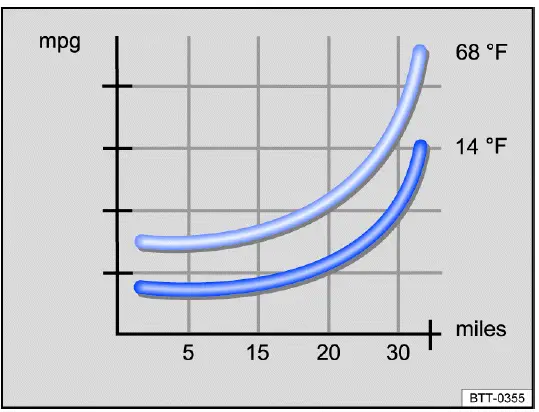
Fig. 106 Fuel consumption in mpg at two different ambient temperatures.
Using the freewheel function
Vehicles with an automatic transmission: If neither the accelerator nor the brake pedal is pressed in the selector
 lever
position, the vehicle can roll using the coasting feature without additional engine power. This can help reduce fuel use in suitable driving situations, such as gentle downhill sections or when approaching slower traffic early.
lever
position, the vehicle can roll using the coasting feature without additional engine power. This can help reduce fuel use in suitable driving situations, such as gentle downhill sections or when approaching slower traffic early.
The freewheel function should be used only when it fits the road and traffic conditions. The driver must always remain ready to brake and must not allow the vehicle to gain unsafe speed.
How to save energy when shifting gears
Early upshifting saves energy at an engine speed of about 2,000 RPM. Do not wait unnecessarily long before upshifting, and avoid high engine speeds when strong acceleration is not needed.
- Vehicles with an automatic transmission: Accelerate smoothly and avoid using the kick-down function unless quick acceleration is truly necessary.
- If possible, use the
 driving mode.
In the Volkswagen Taos, Eco driving mode can help encourage a more efficient setup by adjusting selected vehicle responses. The best results still depend on the driver's habits: smooth acceleration, early planning, and avoiding unnecessary high speeds.
Reducing to idle speed
Start driving immediately at low speeds after starting the engine, instead of letting the engine idle unnecessarily for a long time. When the vehicle will remain stationary for an extended period, do not simply shift to idle and leave the engine running. It may be better to stop the engine, for example in a long traffic jam or at a railroad crossing, when it is safe and appropriate to do so.
On vehicles with an activated start-stop system, the engine can turn off automatically when the vehicle is stopped and stationary. This can reduce fuel consumption and emissions during waiting periods.
Refuel in moderation
A completely full fuel tank increases vehicle weight. For regular city driving, a fuel tank that is approximately half to three-quarters full can be a practical balance between range and weight.
This does not mean the vehicle should be driven with too little fuel. Always keep enough fuel for the trip, weather conditions, traffic delays, and unexpected detours.
Avoid short trips
A cold engine uses significantly more fuel than an engine at normal operating temperature. The optimal temperature is reached only after several kilometers or miles of driving. At very low outside temperatures, such as in winter, fuel consumption is often much higher than average fig. 106. Planning trips more efficiently and combining several short errands into one drive can reduce unnecessary cold starts.
Have maintenance performed regularly
Regular maintenance is essential for fuel-efficient driving and helps increase the service life of the vehicle. Clean filters, correct fluids, proper tire condition, and a well-maintained engine all support smoother operation and lower long-term running costs.
Removing unnecessary weight
Clearing out the luggage compartment, such as removing empty crates, unused tools, or unneeded child restraints, can reduce weight and help lower fuel consumption.
To keep the vehicle's air resistance as low as possible, remove roof boxes, bike racks, and other external attachments after use. Added weight and extra aerodynamic drag can noticeably increase consumption at highway speeds.
Saving energy
The alternator, powered by the engine, generates electricity for equipment such as the climate control system, rear window heating, seat heating, ventilation, lighting, and other electrical consumers. Reducing unnecessary electrical use can support better efficiency, for example:
- When temperatures are high, air out the vehicle before driving and drive short distances with the windows open. Then turn on the climate control system once the hottest air has left the cabin.
- Turn off electrical equipment when it is no longer needed.
Comfort systems are useful, but using them thoughtfully can reduce load on the engine. In everyday Volkswagen Taos driving, small habits such as switching off unused heating or ventilation features can add up over time.
NOTICE
If the vehicle rolls down mountains or hills in neutral
 , the transmission is not lubricated correctly. This can cause the automatic transmission to overheat and may damage it.
- Never leave the vehicle in neutral
 gear, especially when the engine is stopped.
 An authorized Volkswagen dealer or authorized Volkswagen Service Facility can provide more information about correct maintenance and replacement parts that are particularly energy efficient, such as new tires.
 In driving situations when less power is required, the engine cylinders can deactivate automatically on vehicles with Active Cylinder Management (ACT), depending on equipment. When this function is active, no fuel is injected into the relevant cylinders, which can reduce overall fuel consumption.
Efficient driving is not only about one feature or one setting. It is the result of proper maintenance, correct tire pressure, moderate speed, smooth pedal use, and thoughtful use of comfort systems. Applied consistently, these habits help the Volkswagen Taos use less fuel while reducing wear on major components.
Driving a loaded vehicle
When the vehicle is carrying passengers, luggage, tools, equipment, or any other load, its handling can feel different from normal. Extra weight can increase braking distance, change steering response, raise the center of gravity, and make the vehicle react more slowly during sudden maneuvers. For stable handling in the Volkswagen Taos, the load should be distributed carefully and secured before driving.
Heed the following for good vehicle handling when the vehicle is loaded:
- Stow all cargo securely ⇒ Transporting. Heavy items should be placed as low as possible and positioned so they cannot slide forward, sideways, or rearward.
- Accelerate with extra care and caution. A loaded vehicle may respond more slowly, especially when entering traffic, climbing hills, or driving on wet roads.
- Avoid sudden braking and abrupt driving maneuvers. Sharp steering or emergency braking can cause the load to shift and may affect vehicle stability.
- Brake earlier than usual. Additional weight increases the distance needed to slow down or stop safely.
- If necessary, read and heed the information about roof racks ⇒ Roof rack. Cargo carried on the roof affects air resistance and raises the center of gravity.
Before starting a trip, check that the rear seat backrests are locked, loose objects are secured, and the driver's view is not blocked. In the Volkswagen Taos, careful loading is not only about protecting luggage; it also helps preserve predictable steering, braking, and cornering behavior.
WARNING
Loads that slide or shift while driving can seriously impair vehicle stability and safety. During hard braking, cornering, evasive maneuvers, or emergency braking, unsecured cargo can move suddenly, increase the braking distance, strike occupants, or make the vehicle harder to control. This can cause accidents, serious injuries, or fatal injuries.
- Secure the load correctly so it cannot slide, tip over, roll, or move during normal driving or sudden braking.
- Use suitable tie-downs, cargo nets, straps, or securing points for heavy objects.
- Make sure the rear seat backrests and, if equipped, adjustable rear seats are fully engaged and securely locked.
Driving with an open trunk lid
Driving with an open trunk lid can be especially dangerous and should be avoided whenever possible. If a load cannot be transported with the trunk lid closed, secure all objects carefully, secure the open trunk lid correctly, and take precautions to reduce the risk of exhaust gases entering the vehicle interior.
An open trunk lid changes the airflow around the rear of the vehicle and may allow poisonous exhaust gases to be drawn into the cabin. It can also move unexpectedly while driving, especially during braking, cornering, or when driving over rough surfaces.
WARNING
If the vehicle is driven with the trunk lid unlocked or open, loose objects can fall out of the luggage compartment and injure other road users. A load that shifts or drops onto the road can also create a dangerous obstacle for traffic behind the vehicle. This can cause accidents, serious injuries, or fatal injuries.
- Always drive with the trunk lid closed whenever the load can be transported safely with it closed.
- Store all objects in the luggage compartment securely so they cannot fall out or move unexpectedly.
- Drive carefully, look far ahead, and anticipate traffic situations earlier than usual.
- Avoid abrupt acceleration, sudden braking, sharp cornering, and rough maneuvers because the open trunk lid can move in an uncontrolled manner.
- If there is a roof rack or cargo carrier on the trunk lid, always remove it before driving with the trunk lid open.
WARNING
Objects protruding from the luggage compartment change the vehicle length and may endanger other road users, cyclists, pedestrians, or vehicles approaching from behind. Protruding cargo can also affect visibility and make parking or maneuvering more difficult. This can cause accidents, serious injuries, or fatal injuries.
- Follow all legal regulations for transporting long or protruding loads.
- Clearly mark objects sticking out of the luggage compartment so they are visible to other road users.
- Never use the trunk lid to clamp, wedge, or secure objects. The trunk lid and locking mechanism are not designed for that purpose.
WARNING
Engine exhaust gases contain carbon monoxide, an odorless and colorless poisonous gas. If the Volkswagen Taos is driven with the trunk lid open, exhaust gases may enter the interior. This can cause dizziness, loss of consciousness, carbon monoxide poisoning, accidents, serious injuries, or fatal injuries.
- To prevent poisonous exhaust from entering the vehicle, always drive with the trunk lid closed whenever possible.
- Close all windows.
- Close the power sunroof.
- Switch off recirculation mode.
- Open all the air vents in the instrument panel.
- Switch the blower to the highest blower level.
- Always drive with the trunk lid closed if the load can be transported with the trunk lid closed.
NOTICE
Opening the trunk lid changes the height and possibly the length of the vehicle. If the driver does not allow for the changed outer dimensions, the trunk lid, bodywork, hinges, glass, lighting, or nearby objects may be damaged.
- Be aware of the changed outer dimensions, especially when driving through underpasses, garages, parking structures, gates, car washes, or areas with low branches.
Driving through water on roads
Flooded roads can hide potholes, curbs, debris, damaged pavement, open drains, or deeper sections of water. Even when the water looks shallow, entering it too quickly or stopping in it can damage the vehicle. To reduce the risk of vehicle damage when driving through water, for example on flooded roads, follow these precautions:
- The water must not be higher than the lower edge of the vehicle body ⇒
 .
. - Do not drive faster than walking speed. A slow, steady pace helps reduce the bow wave and lowers the chance of water entering critical areas.
- Never stop the vehicle, drive in reverse, or stop the engine while in water. Stopping can allow water to rise around the vehicle or affect the engine and exhaust system.
- Oncoming vehicles create waves that can raise the water level around your vehicle enough to make the crossing unsafe.
- Always manually deactivate the start-stop system when driving through water ⇒ Start/Stop system.
After passing through water, continue carefully and check whether the brakes respond normally. In the Volkswagen Taos, brake performance may feel reduced for a short time after water contact, so the driver should allow extra stopping distance until the brakes are dry.
WARNING
When driving through water, mud, slush, or similar conditions, the braking effect may be delayed because the brake rotors and brake pads can become wet or icy. In winter, this delay may be stronger if moisture freezes on brake components. Reduced braking performance can extend the braking distance and may lead to loss of vehicle control, accidents, serious injuries, or fatal injuries.
- Perform careful braking maneuvers to dry the brakes and remove moisture or ice, but only when it is safe to do so.
- Do not endanger other road users or disregard legal regulations while drying the brakes.
- Avoid abrupt or sudden braking immediately after driving through water, unless emergency braking is necessary.
NOTICE
Driving through water can seriously damage or corrode parts of the vehicle, including electronic components, connectors, sensors, drivetrain parts, brakes, suspension components, and the underbody. Salt water is especially harmful because it can cause rapid corrosion and long-term electrical problems.
- Never drive through salty water.
- Using fresh water, immediately rinse any parts of the vehicle that may have come into contact with salty water.
- Protect electronic components against contact with water whenever possible.
After driving through deep water, salty water, mud, or slush, inspect the vehicle for unusual noises, warning lights, vibrations, reduced brake response, or visible leaks. If anything feels abnormal, have the Volkswagen Taos checked by qualified professionals before continuing long-distance driving.
Operating the vehicle in different countries and continents
Approval regulations
The vehicle is manufactured at the factory for a specific country or market region and is configured to meet the approval requirements, technical rules, and legal regulations that applied there at the time of production ⇒
 .
.
This means that lighting, emissions equipment, safety-related systems, radio functions, service specifications, and other vehicle features may be designed for one market and may not fully match the requirements of another country. Before using the Volkswagen Taos outside its original market, it is important to understand that local laws can affect how the vehicle may be driven, registered, serviced, or inspected.
 If the vehicle will be used temporarily or only for a short period in another country, read and observe the following information before the trip.
Safety standards and regulations
Some countries have special safety standards, registration requirements, lighting rules, emissions regulations, road equipment obligations, and inspection procedures that may differ from the original vehicle configuration. Volkswagen recommends obtaining information about the applicable legal regulations from an authorized Volkswagen dealer or authorized Volkswagen Service Facility before driving in other countries.
For example, a country may require certain warning equipment, specific headlight settings, emissions documentation, tire markings, or other vehicle-related items. Checking these requirements in advance can prevent delays, fines, inspection problems, or unexpected service needs during travel.
Selling in other countries
If the vehicle is sold in another country or will be used there for an extended period, all applicable legal regulations in that country must be observed. Long-term use can involve more than simply driving the vehicle across a border; it may require technical changes, inspection, registration, emissions compliance, or documentation accepted by the local authorities.
Certain equipment may need to be installed or removed, and some functions may need to be deactivated or adapted. The type and scope of required service may also be affected. This is especially important if the Volkswagen Taos is operated for a long time in a different climate region, such as an area with extreme heat, severe cold, high humidity, dusty roads, high altitude, or fuel quality that differs from the original market.
Functions of the Infotainment system
Because radio frequencies, mobile network bands, navigation data, online services, and regional communication standards vary around the world, the Infotainment system installed at the factory may not function fully in other countries. Some features may be limited, unavailable, or may work differently depending on the local network, map coverage, radio band, or service provider.
Before traveling or relocating with the vehicle, check whether navigation, connected services, emergency-related functions, radio reception, and mobile device features will operate correctly in the destination country. This helps avoid relying on a system function that may not be supported outside the original region.
 Volkswagen is not responsible for damage to the vehicle caused by substandard fuel, insufficient service, incorrect fluids, unsuitable replacement parts, or failure to use Volkswagen Genuine parts where required.
 Volkswagen is not responsible if the vehicle does not meet all applicable legal requirements in other countries or continents.
WARNING
At high altitudes, the air density is lower. Because of the reduced oxygen content in the air, engine power may decrease, and extended operation at high altitude can place additional stress on vehicle components. Reduced engine power can make passing, climbing, accelerating into traffic, or driving with a heavy load more difficult. This may lead to dangerous situations, accidents, serious injuries, or fatal injuries.
- Before driving abroad, obtain information from a suitably qualified professional, especially if the vehicle will be operated above 3000 m, or around 9843 ft, above sea level. Volkswagen recommends contacting an authorized Volkswagen dealer or authorized Volkswagen Service Facility.
When planning international travel, also consider fuel availability, service access, required documents, local traffic rules, and whether the vehicle equipment is suitable for the route. Careful preparation helps keep the Volkswagen Taos reliable and legally compliant when used outside its original country or continent.